Categories
Blog finance & forex
CRM Development for Financial Services & Banking: Features, Benefits, and Implementation
Finance & Forex

CRM Development for Financial Services & Banking: Features, Benefits, and Implementation

CRM for financial Fintech industry

GEt in Touch


    The financial services industry has always been based on relationships, trust, and personalized service. However, digital transformation and the expectations of digitally savvy customers have changed the way customers interact with their banks and financial institutions. Customers are no longer satisfied with traditional banking; they expect personalized advice, quick resolutions, and seamless experiences from their banks. To address these evolving needs, many institutions are now partnering with a financial software development company to deliver innovative and customer-centric solutions.
    This is where Customer Relationship Management (CRM) is said to play an innovative role in the financial services industry. Banks and financial service providers can use a cohesive CRM system to gather customer data at a single place, streamline banking operations, enhance service quality, and identify newer opportunities to do business. CRM is not just software, but a strategic enabler of customer-centric growth in financial services.

    What is CRM in Banking?

    CRM in banking refers to the software and strategies that monitor and analyze customer interactions and data throughout their lifecycle with a company. Banking CRM is different from general CRMs and is designed for the needs of financial institutions and includes customer data management, regulatory compliance, and delivery of personalized services.
    A banking Customer Relationship Management (CRM) system collects all customer data from different channels, such as branch visits, bank application, call center, and online banking platform, and integrates them into a single view. Such an approach gives the banks an idea about their customers’ behavior, foresee their needs, and offer services proactively. Understanding the key CRM development features and benefits helps banks make the most of such systems
    In short, customer relationship management in banking works as a bridge joining financial product services to customer needs and desires, ensuring the services are accessible and relevant.

    Why Do Banks & Financial Industries Need a CRM?

    The financial sector is based on one of the most regulated and competitive environments. Clients can switch providers by seeing a single negative customer experience. There are a few reasons why banks and financial institutions need a CRM, and they are:
    • Data-driven decision making – To get actionable insights from large volumes of transactional and customer data, institutions need tools.
    • Changing customer expectations – Customers of today expect personalized, faster, and 24*7 services.
    • Competitive differentiation – Create stronger relationships by offering personalized offers, enhanced services, and loyalty programs.
    • Regulatory compliance – While adhering to privacy regulations like GDPR, CRM systems offer secure ways to manage data.
    • Operational efficiency – Staff will be able to focus on high-value customer interactions by automating routine tasks.
    Banks and financial institutions will end up offering inconsistent, fragmented, and outdated customer experiences without having a proper CRM in place.

    Key Benefits of CRM in Banking

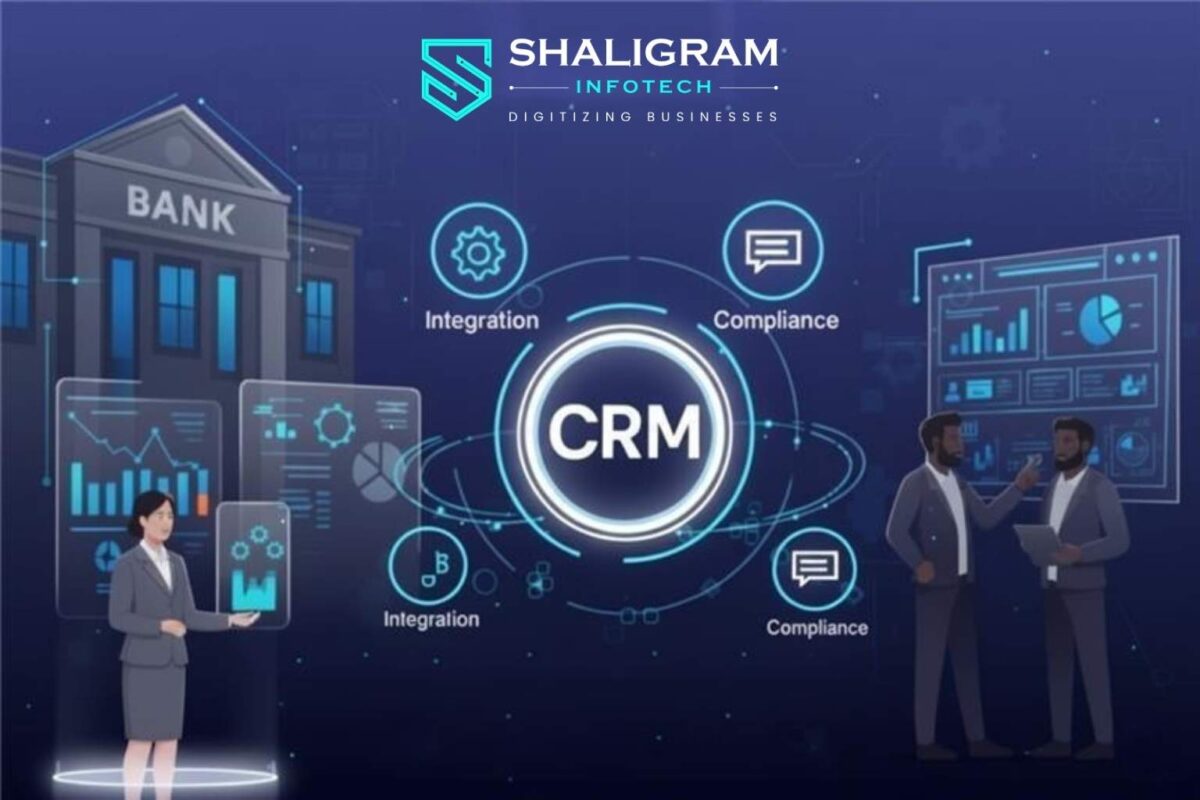
    Professionals using holographic CRM in a futuristic ban

    Personalized Customer Experience

    Through centralization of customer data, CRM software lets banks offer customized services while having a complete view of customer interactions. They will be able to connect with customers one-to-one, offer seamless experiences, and deliver their needs by getting a complete overview. Through customized solutions, banks will be able to offer enhanced experiences while ensuring customer satisfaction

    Enhanced Sales and Cross-Selling

    CRM software examines customer data to get insights on their likes and dislikes to identify upselling and cross-selling opportunities. Banks will be able to generate sales and revenue by offering the right products and services beforehand. The software will help them approach customers individually by identifying where any additional products or services would be of interest to a given customer. Banks can create more valuable customer relationships, expand wallet share, and drive revenue expansion by exploring the potential of cross-selling.

    Improved Customer Retention

    Banks are facing the issues of customer churn. By looking into past data and forecasting, banks get to reduce this through CRM tools. This lets them work on activities that can help retain customers. With CRM, personalized banking experiences can be delivered which will in turn help them build customer loyalty.

    Data-driven decision making

    With CRM software, banks can better understand their customers as it offers them advanced analytics. With it, they can tailor and personalize their campaigns and products. Moreover, they will be able to identify profitable channels for selling their services and products by using advanced information and forecasting functions. The software constantly analyses each transaction to look for patterns that can be harmful. This helps them build a secure banking system while preventing any risks. Data-driven decisions with Dynamics 365 services support these functions and help banks use analytics more effectively.

    Efficient customer service

    By bringing together customer data to let support groups respond more accurately and faster, CRM solutions automate customer service processes. Automated follow-up and communication procedures will help respond to the right customer at the right time with the right information. By analyzing customer behavior and needs, banks can forecast customer issues and address them by offering customized solutions, thereby leading to low churn and high loyalty. This will lead to a drastic decrease in query resolution times and a significant increase in customer satisfaction scores.

    Compliance and risk management

    When it comes to compliance management for banks and financial institutions, CRM software plays a key role as it offers a centralized, integrated platform for managing, tracking, and reporting information. It stores and processes customer data including transaction history, KYC data and risk data by following compliance rules.

    CRM solution offers advanced reporting functionality to track transactions and interactions with customers, generate paperwork regulatory auditing, and alert compliance related potential risks. CRM solution is supported by regulatory auditing which leaves fewer chances for error, saves time, and generates reports with desired data in requested format. CRM for financial services helps carry out customer due diligence by classifying customer data from various sources and analyzing them.

    Streamlined operations

    CRM systems can centralize customer data and automate routine tasks. This streamlines operations and lets the team deal with crucial customer problems. Apart from that follow-up processes and communication can also be automated with CRM systems. This ensures that the right information is made available to customers at the right time. Such a streamlined approach helps banks to improve customer retention while reducing the costs related to acquiring new customers.

    Customer acquisition

    By addressing customer issues proactively, delivering personalized customer experiences, and building trust through professional interactions and secure data handling, banks will be able to attract new customers. CRM will help financial institutions to plan and carry out targeted marketing strategies to attract potential customers.

    Improved employee productivity

    CRM systems enhance operational efficiency by letting employees focus more on customer needs by centralizing customer data, and by automating routine tasks. CRM systems will ensure the right information reaches the customers at the right time by automating follow-up processes and communications. CRM systems centralize customer information by streamlining customer service operations, thereby offering accurate and faster responses by empowering support teams.

    Must-Have Features of a Banking CRM System

    Enhanced Security Measures

    The banking sector cannot ignore the need for security, and advanced security features are offered by CRM systems to protect sensitive customer data. CRM software secures banking assets from cyber threats and ensures regulatory standards are met by including features like role-based access controls, encrypted transactions, and regular data backups.

    Advanced Dashboard and Reporting

    CRM software for banks and financial institutions comes with an easy-to-use dashboard, data analytics, and reporting capabilities that can help banking staff work efficiently. These dashboards assist banking staff in making informed decisions efficiently and quickly by offering actionable data and real-time insights.

    Easy Integration

    For ease of working, CRMs developed for banks can seamlessly integrate with third-party applications as well as other existing banking systems like reporting and loan management systems. This will help you maximize the value of your CRM investment while ensuring a smooth transition. From long-term strategic analysis to daily operations, such reports offer banks a clear picture of the areas for improvement and the areas where they are performing well.

    On-the-go Accessibility

    It is crucial to have an on-the-go CRM for the banking and financial sector to keep up with this mobile-first world. The feature of mobile CRM lets the team stay productive from anywhere, anytime by having direct access to customer data, responding quickly to inquiries, and taking care of key tasks on the go.

    Scalability

    Your CRM solution must scale to meet your growing needs as your banking operations expand. Scalability will ensure that CRM solutions can seamlessly handle all your business customer data and additional functionalities without affecting performance in any way. This flexibility will ensure long-term success while supporting the growth strategies of financial institutions.

    Predictive Analytics

    Predictive analytics help banks get clear and crisp information about customer behavior and transaction patterns. This will help them offer personalized products and services by anticipating the needs of customers even before they ask for them.

    Automated Workflows

    One of the key features of banking CRM solutions is workflow automation. It minimizes risks of errors while reducing manual intervention. By automating routine tasks like loan approvals or simple data entry, it will help your team to focus on activities that matter most to them.

    User-friendly Interface

    CRM software for banks needs to be easy to use and can seamlessly meet the needs of all types of users. For the same, it needs to come with an intuitive and visually appealing interface. People belonging to different age groups access banking services and so it is important to invest in seamless UI/UX design that everyone can use.

    360-degree Customer View

    For any CRM platform, having complete customer information is key, and things are not different for banking and financial services. Your CRM for banking should bring together all information on customers including their financial history, interactions, credit scores, and much more. Your staff will be able to get all the required information and offer proper services to customers by having centralized access to everything.

    AI & Analytics in Banking CRM

    The field of Artificial Intelligence (AI) and advanced analytics has revolutionized customer relationship management (CRM) systems in the financial services sector. Banks previously used data scientists to sift through data, but now they can leverage AI to help them to:
    • Predict customer behavior: Identify who is likely to apply for loans, switch accounts, or cancel bank accounts
    • Personalize recommendations: Recommend a client a more appropriate investment plan or a more suitable loan
    • Automate customer service: AI chatbots provide answers to clients’ questions immediately, reducing the dependency on a human agent
    • Fraud detection: Detect suspicious activity in real-time by monitoring suspicious transactions, while also providing an immediate response to possible fraud.
    • Sentiment analysis: Document customer sentiment derived from social media and emails for service improvement.
    Combining AI and CRM allows banks to move from a reactive service model to an active and personalized interaction model.

    CRM Solutions for Different Financial Institutions
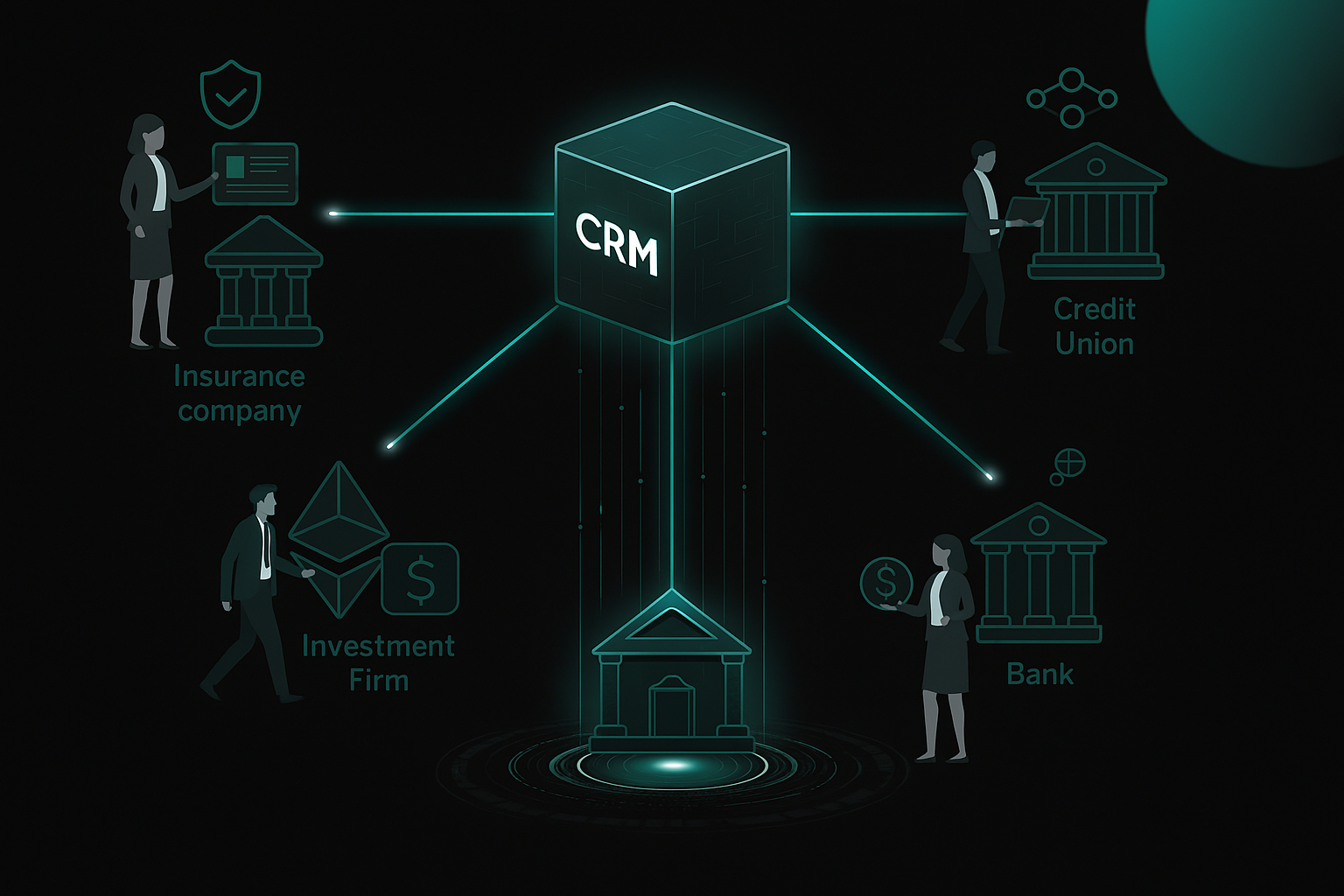
    Different financial institutions linked by central CRM hub

    Financial services vary widely. Retail banks and wealth management firms, for example, serve different client bases and operate in different ways. Each of these businesses may require a CRM system designed for their unique operations.

    CRM for Retail Banking

    Retail banks engage millions of customers on a daily basis. Their CRM requires the following functionality:

    • Simplicity when managing accounts.
    • Personalized financial advice and support.
    • Chatbots, mobile banking apps, and other customer service enhancements.
    • Cross-selling products such as mortgages, credit cards, and savings accounts.

    CRM for Investment Banking

    Investment banks engage with clients worth millions of dollars and manage complex transactions. The CRM used in Investment Banking needs functionality for:
    • Institutional and corporate relationships
    • Investment opportunities
    • Ability to collaborate in real-time across teams
    • Interact across global markets in a compliant manner
    • CRM for Insurance & Wealth Management
    • Manage client policies, renewals, and claims
    • Offer personalized portfolio management advice and communication
    • Use risk profiling and investment tracking tools
    • Provide transparency in reporting and build trust with clients

    CRM for Credit Unions & Regional Banks

    Smaller, regional financial services organizations have unique operations and build relationships with their clients because they are local within communities. These smaller organizations may use a CRM system to:
    • Build member engagement through personalized communication
    • Much simpler loan origination workflow for loans, etc.
    • Support local outreach efforts and manage community programs
    • Provide digital engagement tools in a cost-efficient manner while remaining compliant

    Custom vs Ready-Made Banking CRM
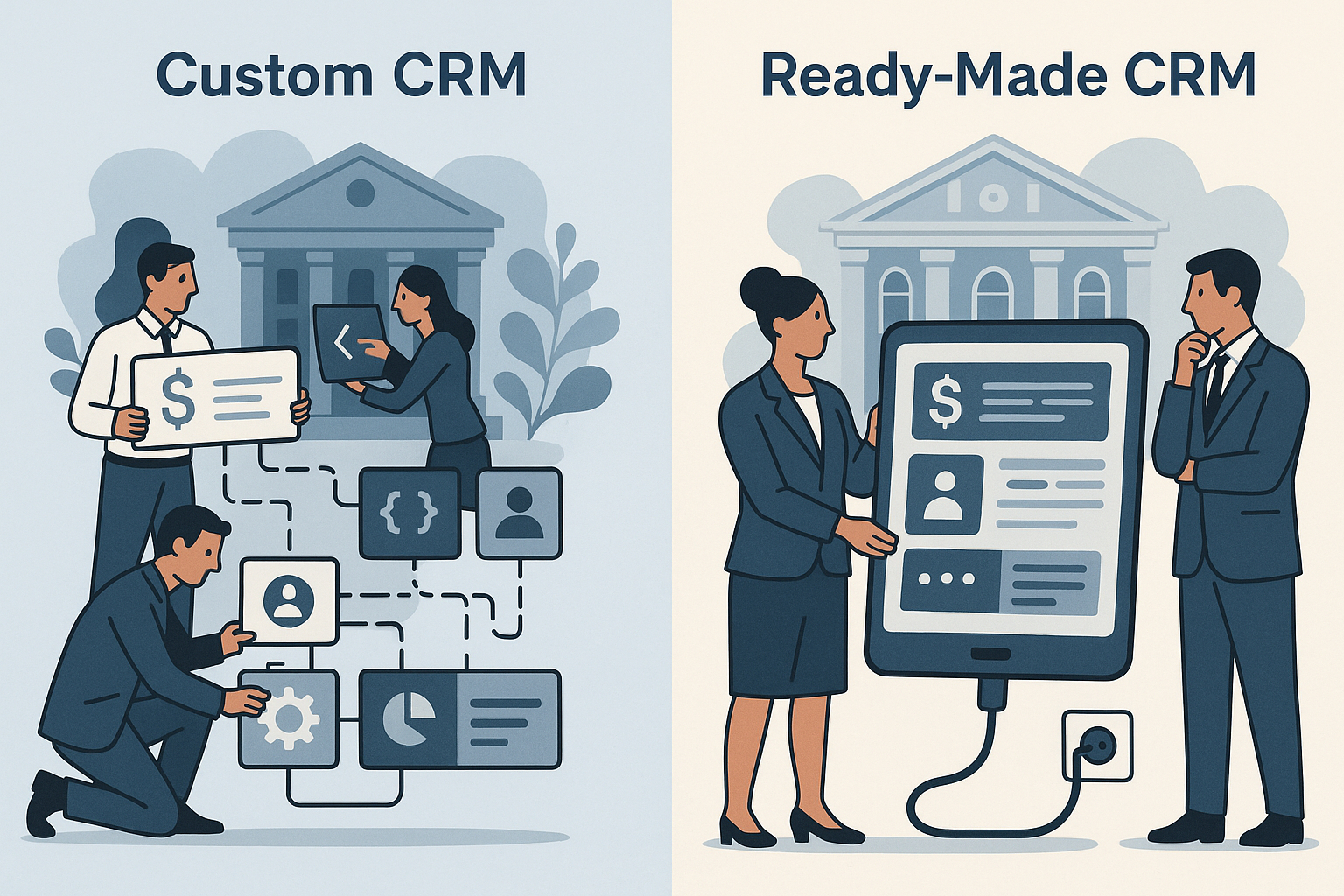
    Split scene showing custom CRM building vs ready-made CRM use
    In CRM implementation, financial institutions typically must decide between having a custom or ready-made solution. Both of these solutions have their own key features.

    Custom CRM:

    • Custom-built to fit the bank’s unique workflows.
    • Integrate flexibly with systems that exist.
    • Larger initial expenditure with long-term value.
    • Longer time for implementation.

    Ready-Made CRM:

    • Initial configuration requires minimal effort.
    • Low initial budget.
    • Minimal customization or scalability.
    • May require adjustment of business processes.
    Depending on the budget, capacity for scalable practices, and complexity of operations, the choice is often clear. The custom route is favored more by larger banks, whereas the ready-made approach fits smaller organizations better.

    Future of CRM in Banking & Financial Services

    In banking, CRM is evolving from simple customer management to become essential infrastructure for digital-first financial services. The future will be all about smarter, faster, and more personalized experiences
    One of the most significant transformations will be the move to hyper-personalization. Through AI and behavioral analytics, banks and FinTech’s will shift from offering generic products to designing personalized financial journeys. For example, they may offer home loans at the right moment as soon as customers start exploring real estate or offer retirement plans only to customers in the right life stage.
    As conversational and voice-enabled banking develops, customers will engage banks more frequently through chatbots and voice-enabled technologies. As this unfolds, the entire conversation can be documented in the CRM. When combined with predictive analytics, this will allow banks to anticipate customer needs before they are even expressed – and be proactive advisers instead of reactive product providers.
    Security and trust will remain at the center of the future of banking, and we may even see the first blockchain-enabled CRM platforms that securely store customer data and contracts, that are tamper-proof. Moreover, real-time data processing will make it possible to provide instantly approved loans or recommendation decisions, for fraud detection or even investment recommendations, all through real-time processing, which increases the potential to reduce inconvenience.
    Embedded finance will also impact the future evolution of CRM. Banking services will increasingly be offered within e-commerce, travel or lifestyle platforms. CRMs will need to continue innovating to provide solutions within those ecosystems where banks and customers keep connected, happy, and satisfied, irrespective of the experience the product may be contained in.
    In summary, CRM software for the financial services industry will deliver experiences that are secure, personalized, and effortless by combining human and machine intelligence. Banks that invest in next-gen systems will not only meet the expected outcomes of their customers but likely set new benchmarks of trust and innovation for both current and future clients.

    Conclusion

    CRM is no longer a ‘nice to have’ for banks or companies offering financial services, but imperative. Whether it’s improving customer experience, compliance, or simply driving revenue, CRM is crucial to building trust, revenue growth, and innovation. Shaligram Infotech, recognized as the best software developer company in India, helps financial service providers implement AI-powered CRM solutions tailored to their needs. Financial Services companies adopting such solutions will be very well placed to compete as customer-focused businesses in the future. The banks of tomorrow will be those that successfully blend technology with human relationships.

    💬 Want regular insights on CRM in fintech?

    Follow Shaligram Infotech on LinkedIn
    Let’s build the future of finance, together.

    FAQs

    Why is opting for CRM software in financial services beneficial?

    CRM helps financial institutions greatly improve their customer journey, lower barriers to assist with cross-sells, increase and simplify compliance, and improve operations with automated workflows and business intelligence
    AI allows CRM to be smarter and more proactive; it powers predictive analysis, fraud detection, omnichannel support, automates customer support with chatbots, and promotes personalized product recommendations.
    When searching for a banking CRM system, look for features such as a 360-degree customer view, omnichannel customer support, automated workflows, AI insights, compliance components, and strong integration functionality.
    Customer retention in banking can be improved through the use of CRM by providing personalized messages with automated reminders to clients, offering loyalty programs, and proactively offering innovative services. Contact us now to learn how our CRM solutions can help you increase customer loyalty and retention.
    The future of banking CRM will benefit banks with AI, Blockchain, or predictive analytics that can provide hyper-personalized, secure, and innovative service in the financial services industry.