

Flutter vs React Native: Which Cross-Platform Framework Should You Choose?

GEt in Touch
| Table |
|---|
Choosing the right cross-platform framework is among the most crucial choices a contemporary product team faces. It has far-reaching implications not only on the first release delivery speed but also on the app efficiency in real usage, as well as on the engineering team scalability and the maintenance cost reduction in the long run. In 2026, the choice tends to fall between Flutter and React Native, two frameworks that lead the mobile development scene. Many growing companies even choose to hire dedicated Flutter developers to speed up delivery and maintain consistent UI quality.
Cross-Platform Framework Comparison: Flutter vs React Native
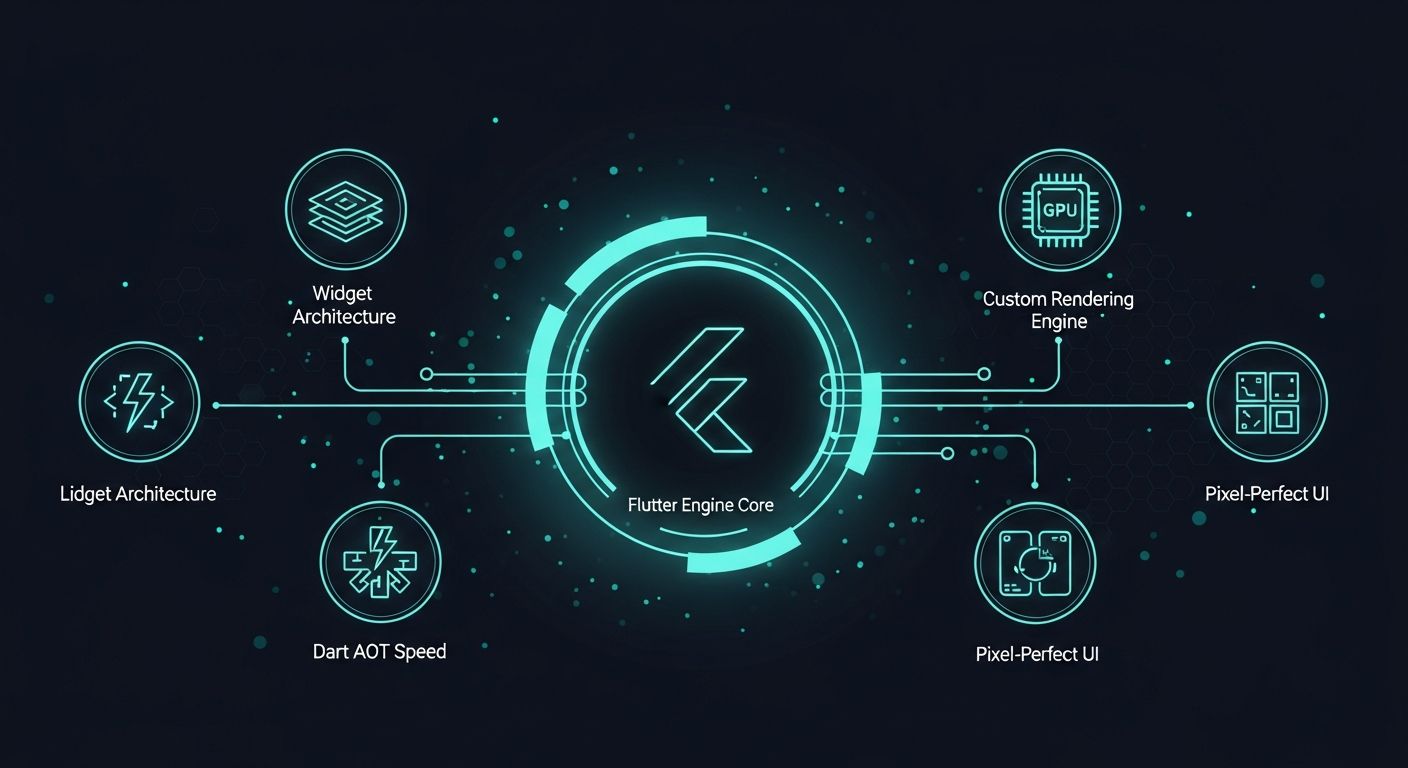
Flutter and React Native have two completely different ways to think about the issue of cross-platform development. Flutter, for example, uses its own rendering engine and produces an identical user interface that looks the same on all devices. Meanwhile, React Native, by employing the real Android and iOS components and tying them together via JavaScript logic, tries to get the look and feel of the native components. One reason companies often hire dedicated React Native developers is when they want a more web-aligned architecture. The results of both methods are very good, but they are different in terms of the application area.
When comparing Native vs Cross-Platform Mobile Apps, teams often look at development speed, UI flexibility, and long-term scalability to decide which approach aligns best with their product goals.
What Is Flutter App Development?
What Is React Native Development?
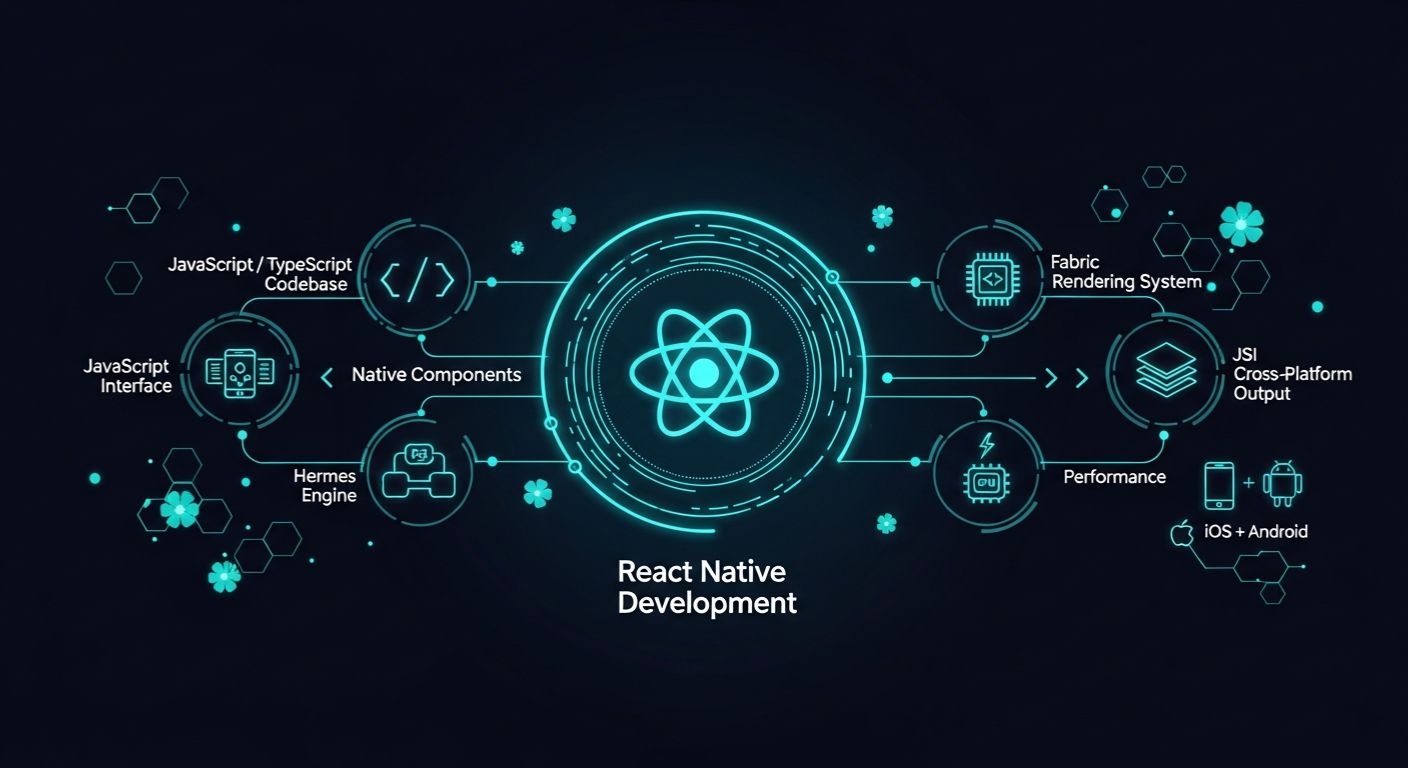
React Native, conceived and brought to life by Meta, offers a JavaScript or TypeScript solution to the use of the world’s most popular UI library, React, for mobile application development. Modern React Native has moved beyond the traditional “bridge.” By leveraging the New Architecture (Fabric and TurboModules) and JSI (JavaScript Interface), JavaScript code now communicates directly with native components in C++. This eliminates the serialization “toll” of the past, allowing React Native apps in 2026 to handle complex gestures and high-frequency updates with near-native efficiency. React Native provides a faster and more unified path by blending performance with a shared JavaScript codebase, aiming to close the gap on the superior UX delivered by native applications.
React Native vs Flutter Performance: Benchmarks & Reality
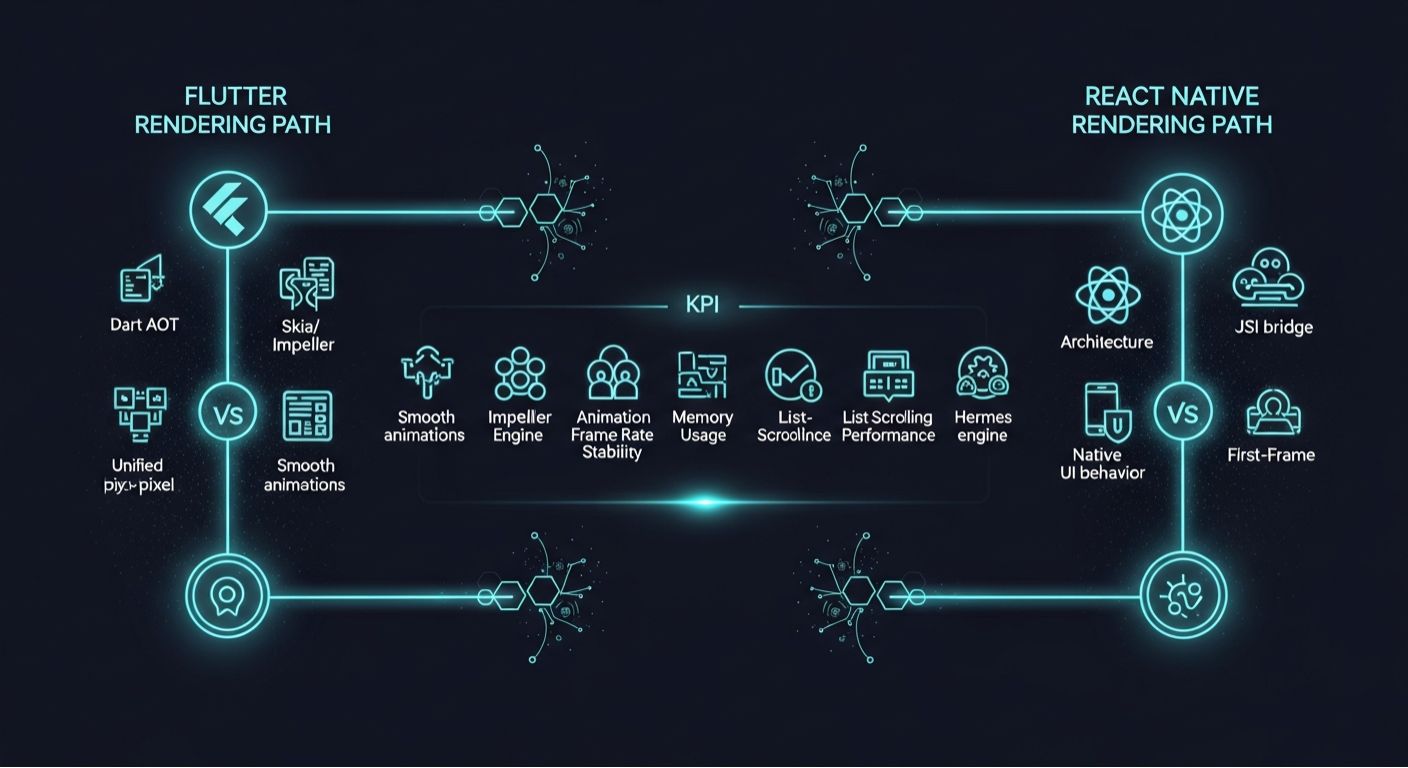
Rendering Paths & Engines (Dart AOT + Skia/Impeller vs RN w/ Fabric & Hermes)
Practical KPIs to Track
React Native Single Code Base: How Much Do You Really Share?
Flutter vs React Native Advantages by Use Case
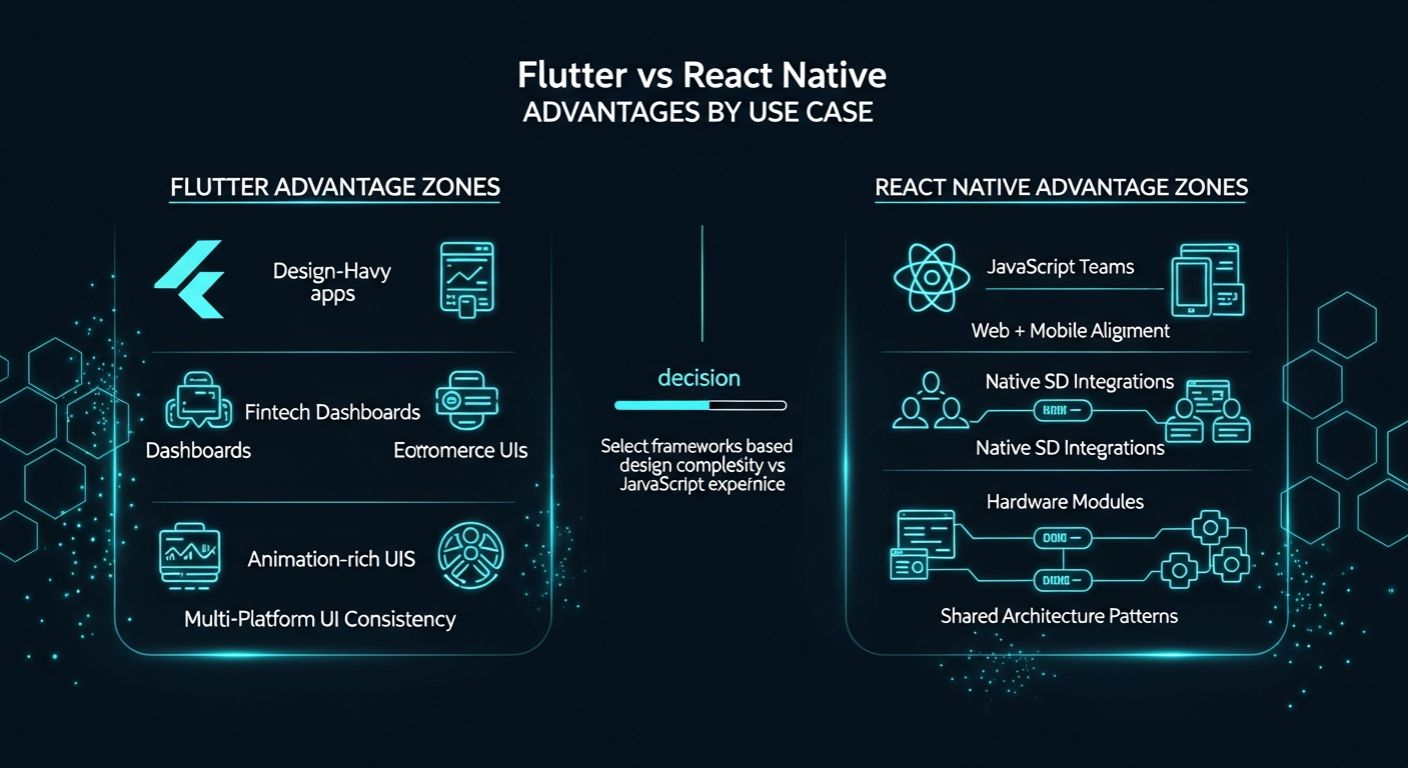
Design-Heavy Apps
Teams with JS expertise, Web + Mobile Alignment
Choose
- Flutter if: You are building a banking app or bespoke e-commerce store where “pixel-perfect” design across iOS/Android is non-negotiable.
- React Native if: You are a startup with existing React.js developers, or your app relies heavily on native integrations (e.g., complex Bluetooth or background location services).
Choose a Mobile App Framework by Constraints (Decision Matrix)
To make the decision easier:
React Native vs Flutter for Mobile Apps: Real-World Scenarios
Think about the application of each framework in actual business scenarios. A fintech app that uses complex charts and animations will probably take advantage of Flutter’s rendering consistency. A React-skilled startup that is releasing its first mobile application can reduce the timelines significantly by opting for React Native due to the tooling and web development shared understanding being so familiar. React Native’s native-first method is often preferred by businesses developing applications that require heavy OS integration, device-level features, and hardware modules. Lastly, companies that are creating a multi-screen ecosystem, mobile, desktop, kiosk, and web, usually choose Flutter because of its consistent rendering approach. As a top mobile app development company India, we often guide businesses in selecting the right framework based on their product vision and long-term scalability needs.
Cross Platform App Delivery Playbooks
Flutter Development Checklist
- Select an architectural pattern: BloC, Riverpod, MobX, or Redux.
- Establish CI/CD pipelines with Codemagic or GitHub Actions.
- Reduce the number of redundant widget rebuilds.
- Activate Impeller for more fluid rendering.
- Implement a uniform design system.
- Perform asset and image size optimisations.
- Conduct thorough testing on budget Android devices.
- Leverage DevTools for memory and CPU profiling.
React Native Development Checklist
- Set TypeScript as the language of choice
- Modern navigation libraries are to be adopted
- Enable the Hermes engine as the default
- Library support for Fabric is preferred
- UI performance can be achieved using tools like Reanimated or FlashList
- OTAs can be updated through Expo or CodePush
- Launch testing for platform-specific edge cases early
Cost, Team & Hiring: Flutter Development vs. React Native Development
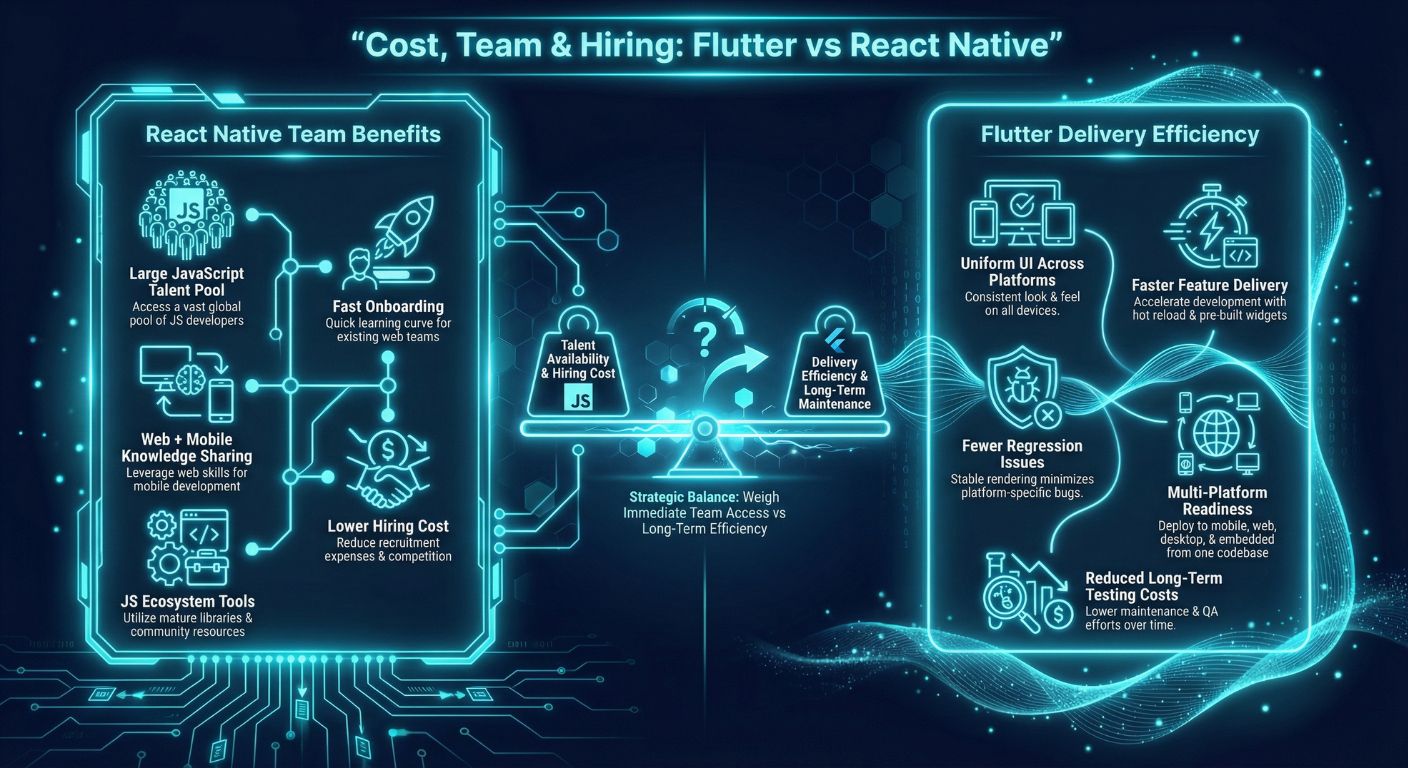
On the other hand, Flutter might be a more financially viable option from a delivery standpoint, especially for applications with a lot of design work or for products that are aimed at multiple platforms. The reason is that Flutter’s UI is so uniform that programmers spend less time solving the issues that come with different platforms, which speeds up the development of new features and, at the same time, reduces the errors that occur during regression testing. The StackOverflow Developer Survey highlights how widely JavaScript and Dart are adopted globally.
Conclusion : Picking the Right Cross-Platform Mobile Apps Strategy
The decision of whether to go for native or cross-platform development is based on the project goals, performance needs, and budget, in the end. Native applications provide the fastest speed and the best user experience, while cross-platform applications offer quicker delivery and reduced costs with some quality loss, but not too much. Through grasping these dissimilarities, companies can make wiser technology investments that are aligned with their digital strategy in the long run. At Shaligram, we assist organizations in assessing both strategies and crafting solutions that offer the perfect mix of performance, scalability, and value. As a leading software development company in India, Shaligram Infotech assists organizations in assessing both strategies and crafting solutions that offer the perfect mix of performance, scalability, and value.
Ready to build? Contact our global teams:
💬 Interested in Regular Insights on Mobile Development?
Let’s build the future of applications together.
FAQs


 Get In Touch