
Categories
Blog Software Development
Choosing the Right Architecture for SaaS Products
Software Development

Choosing the Right Architecture for SaaS Products

SaaS architecture showing application layers and cloud infrastructure

GEt in Touch


    Why Choosing the Right Architecture for SaaS Products Matters

    SaaS products differ fundamentally from traditional software. They must serve multiple users simultaneously, deliver updates without downtime, and remain available at all times. As usage grows, the system should scale automatically without degrading performance or reliability.
    Poor architectural decisions often result in slow feature releases, frequent outages, rising cloud costs, and security risks. In contrast, a well-designed SaaS architecture enables faster development cycles, better fault isolation, regulatory compliance, and the ability to respond quickly to market demands. Ultimately, architecture has a direct impact on customer satisfaction, operational efficiency, and long-term profitability.

    What Is SaaS Architecture?

    SaaS architecture is a software delivery model where a single, centrally hosted application serves multiple customers (tenants) over the internet. It governs how components interact, ensures secure data isolation, and utilizes cloud-native infrastructure to scale resources dynamically based on demand.
    Unlike on-premises software, SaaS applications must support multi-tenancy, automated deployments, high availability, monitoring, and disaster recovery. A strong architectural foundation allows a SaaS platform to grow without constant reengineering.

    Different Types of SaaS Architecture

    There is no universal architecture that works for every SaaS product. The right approach to SaaS product design depends heavily on architectural decisions that strike a balance between scalability, security, and long-term maintainability.
    Common architectural decisions include choosing between monolithic and microservices designs, deciding how tenants share infrastructure, and selecting communication and data storage models. Each option involves trade-offs that must be evaluated against business goals.

    Monolithic vs Microservices Architecture for SaaS

    Monolithic vs microservices SaaS architecture comparison

    Monolithic Architecture

    A monolithic architecture packages the entire application into a single unit. In recent years, many startups adopt a Modular Monolith approach, organizing code into distinct modules within one codebase. This provides the simplicity of a monolith for early validation while allowing an easier transition to microservices later.

    Monoliths enable faster iteration for MVPs and early validation. However, as the product grows, scaling becomes inefficient and changes in one area can affect the entire system.

    Microservices Architecture

    Microservices architecture breaks the application into independent services that communicate through APIs or events. Each service can be developed, deployed, and scaled independently.

    This approach improves scalability, resilience, and release velocity for mature SaaS platforms, but it introduces operational complexity. Microservices require strong DevOps practices, service orchestration, and monitoring.

    Microservices are best suited for SaaS products that have outgrown monolithic limitations and require long-term scalability. Cloud providers such as Google Cloud explain how microservices architecture enables independent scaling, fault isolation, and faster release cycles for growing SaaS platforms.

    Single-Tenant vs Multi-Tenant Architecture
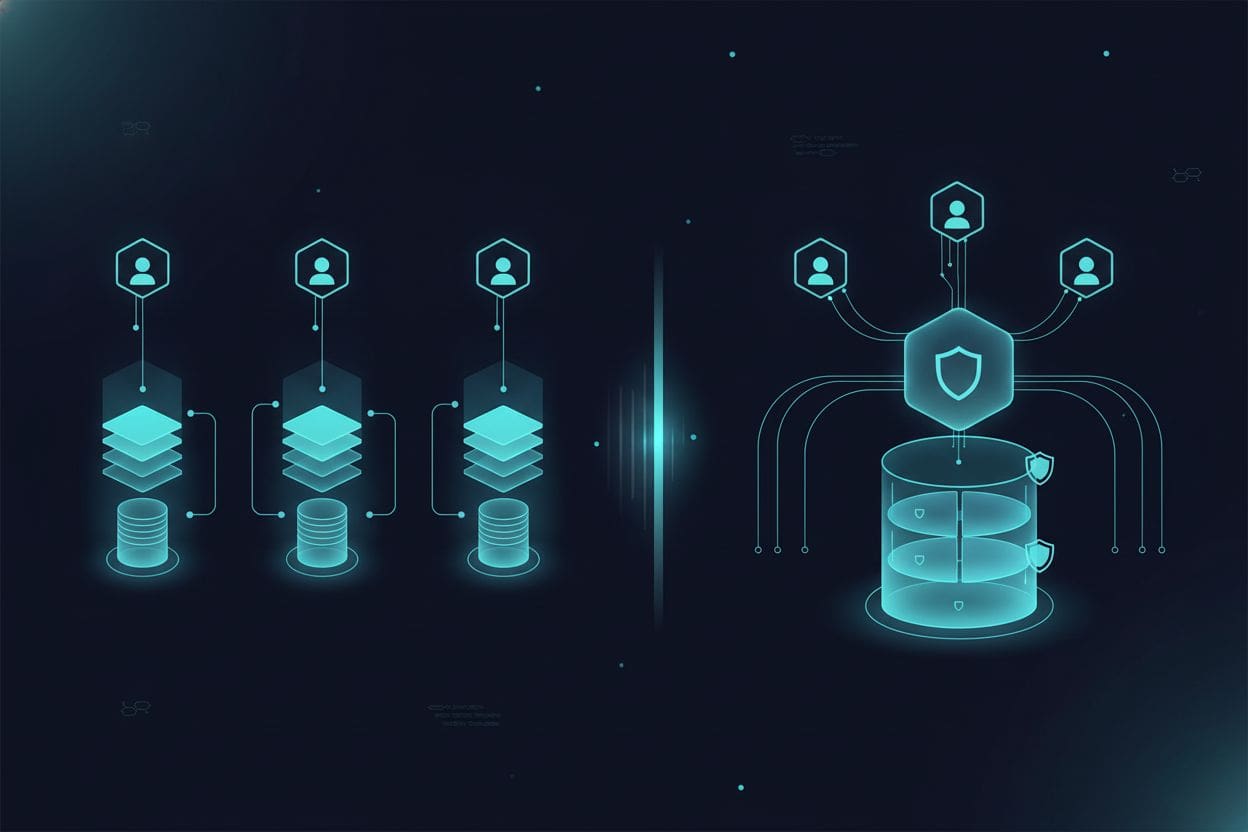
    Single-tenant and multi-tenant architecture models for SaaS systems

    Single-Tenant Architecture

    In a single-tenant model, each customer has a dedicated application and database instance. This provides strong data isolation and customization, making it suitable for regulated industries such as healthcare and finance.
    The trade-off is higher infrastructure and maintenance costs, along with increased operational overhead as the number of customers grows.

    Multi-Tenant Architecture

    Multi-tenant architecture allows multiple customers to share the same application instance while keeping data logically isolated. This model is widely used in modern SaaS platforms due to efficient resource utilization and simplified updates.
    The main challenge is ensuring strong security, tenant isolation, and consistent performance across customers. When implemented correctly, multi-tenancy offers significant scalability and cost advantages.

    SaaS Database Architecture: Choosing the Right Data Model

    Database Options for SaaS Products

    SaaS platforms often use a combination of relational and NoSQL databases. Relational databases handle structured data and transactions, while NoSQL databases support flexible schemas and horizontal scaling.
    Many modern SaaS products adopt a hybrid approach based on workload requirements.

    Data Isolation Models in SaaS

    Data isolation can be implemented using shared databases with tenant identifiers, separate schemas, or dedicated databases per tenant. Each approach balances cost, complexity, and security differently.

    Strong access controls and encryption are essential regardless of the chosen model.

    Best Practices for SaaS Data Architecture

    Effective SaaS data architecture emphasizes horizontal scaling, efficient querying, backups, disaster recovery, and governance. Planning for data growth early avoids costly redesigns later.

    Cloud Architecture and Infrastructure for SaaS Applications

    Cloud architecture and infrastructure supporting scalable SaaS applications

    Cloud Deployment Models

    Public cloud platforms are the most common choice for SaaS deployments, though some organizations adopt hybrid or multi-cloud strategies. Public cloud environments provide scalability, global access, and managed services. In complex environments, cloud consulting services in India help SaaS businesses design secure, scalable cloud architectures while aligning infrastructure decisions with long-term growth plans.

    Cloud-Native Architecture Components

    Cloud-native SaaS platforms rely on containers, orchestration tools, managed databases, and CI/CD pipelines. These components enable automated scaling, high availability, and continuous delivery.

    Key Cloud Infrastructure Considerations

    Availability, security, monitoring, and cost optimization are essential. Observability tools help teams monitor performance and usage while controlling infrastructure expenses. Leading cloud providers such as AWS outline proven SaaS architecture patterns that emphasize scalability, availability, and cost optimization across cloud-native environments.

    SaaS Platform Design: Architecture Patterns to Consider

    Established patterns such as layered architecture, domain-driven design, and event sourcing help manage complexity and improve maintainability. Selecting appropriate patterns ensures the platform remains adaptable as business requirements evolve. The choice of web app development frameworks significantly impacts how SaaS platforms manage performance, scalability, and integration with cloud infrastructure.

    Scalable SaaS Architecture Best Practices

    • Stateless services for horizontal scaling
    • Caching to reduce latency and load
    • Automated infrastructure provisioning
    • Proactive monitoring and observability
    • Failure-aware design for resilience

    Common Mistakes When Choosing SaaS Architecture

    Many teams overengineer early by adopting complex architectures too soon. Others underestimate data isolation, security, or monitoring requirements. Ignoring future growth during early design often leads to expensive refactoring later.
    Aligning architectural decisions with realistic growth plans helps avoid these issues.

    How to Future-Proof Your SaaS Software Architecture

    Future-ready SaaS architecture emphasizes modular design, cloud-native technologies, automation, and continuous evaluation. Flexible systems adapt more easily to changing technologies and market demands.

    Conclusion

    Choosing the right SaaS architecture is a long-term commitment to scalability, performance, and business resilience. While no single model fits every product, thoughtful architectural decisions aligned with business goals create a strong foundation for sustainable growth. Many organizations partner with a software development company in India to design robust SaaS architectures that support long-term growth and operational stability.
    At Shaligram Infotech, we design SaaS architectures that are secure, scalable, and future-ready, enabling organizations to build platforms that grow confidently and adapt without unnecessary complexity.

    Ready to build? Contact our global teams:

    🇺🇸 USA: +1 (919) 629-9671
    🇬🇧 UK: +44 20 3581 6366
    🇮🇳 India: +91 99099 84567
    🇦🇺 AUS: +61 07 3121 3147

    💬 Interested in Regular Insights on SaaS Product Development?

    📲 Follow Shaligram Infotech on LinkedIn
    Let’s build the future of applications together.

    FAQs

    What is the best architecture for SaaS applications?

    The best architecture depends on scalability needs, complexity, compliance requirements, and long-term goals. Talk to our experts to identify the ideal SaaS architecture tailored to your business and growth plans.
    Most startups benefit from starting with a monolithic architecture and transitioning to microservices as the product matures.
    It allows multiple customers to share the same application instance while keeping data logically isolated.
    Public or hybrid cloud platforms with cloud-native designs are commonly preferred for scalability and flexibility.

    Relational databases work well for structured data, while NoSQL databases support scalability and flexibility.

    No. Microservices offer scalability but add complexity and are best suited for mature products.