

How Cloud-Based Business Applications Improve Scalability

GEt in Touch
Quick Summary :
Cloud-based business applications help businesses scale faster and smarter by eliminating the limitations of on-premise hardware. They offer on-demand resource allocation, pay-as-you-go pricing, and automated maintenance, making growth more accessible and cost-efficient. Whether you are a startup or an enterprise, cloud solutions provide the flexibility and reliability needed to stay competitive.
In a dynamic market, just providing good services or products can hit a ceiling. If a business really wants to stay ahead in the competition, they have to keep scaling. Entering new markets, new regions, handling evolving customers’ expectations, and integrating new technologies become increasingly complex as you start to scale your business up.
A cloud-based application can help your business in all these aspects. It is more than just a storage option. It allows different departments to collaborate, scale infrastructure, and much more. The best way to get a cloud-based application developed for your business is to hire a company that provides dedicated cloud consulting services in India.
The following blog goes through how cloud-based business applications can help your business scale.
How do Cloud-Based Applications Work?
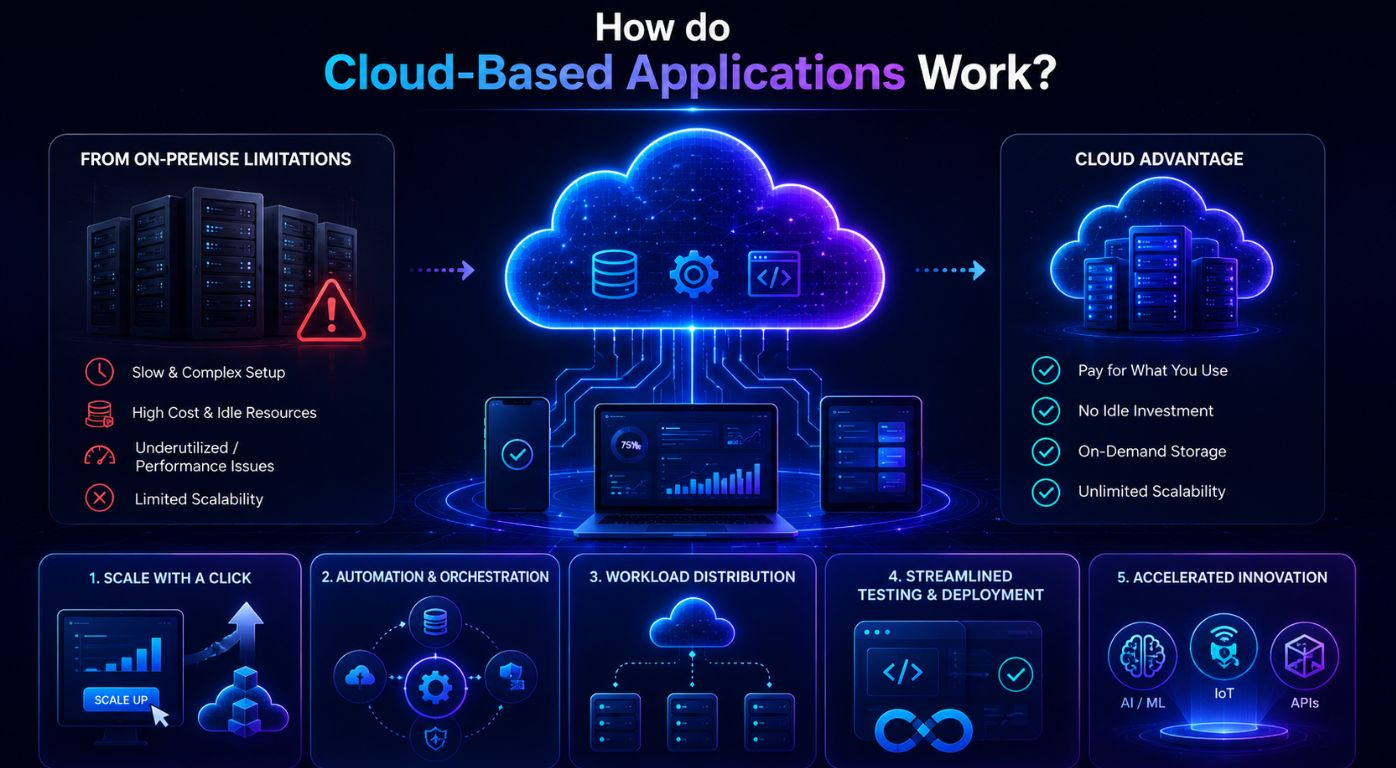
Overcoming the Limitations of On-Premise Scaling
Setting up and managing on-premise hardware can be burdensome and time-consuming. If you do not have experience with IT or do not want to hire a dedicated team for setting it up, then a cloud-based application is the best option. Manual installation can be costly, slow, and disruptive.
In most cases, when businesses install on-premise hardware for scaling, they are not able to utilize it at full capacity. As a result, most of the hardware sits idle, and the money invested sees little to no return. Sometimes businesses incorrectly assume the storage they will require and then struggle with poor performance due to a lack of storage.
On the other hand, with cloud-based applications, businesses only have to pay for what they use, which means there is no “idle” investment and no chance of a lack of storage. Businesses can just buy up storage as they need.
Dynamic and Automated Resource Allocation
Automation is at the heart of cloud-based systems. In fact, it is one of the major reasons why businesses prefer cloud-based applications over on-premise ones.
Scaling at the Click of a Button
Managing IT infrastructure that can keep up with evolving demands can be tough for businesses. On-premise hardware requires a hefty upfront investment. In cloud-based applications, scaling can often be done with just a click of a button. Yes, it is that simple and quick. They provide unprecedented flexibility. You can even scale down if necessary with just a few clicks.
You can adjust resources quickly based on demands. For instance, if you have a seasonal business and are expecting a spike in demand, you can allocate resources without any costly hardware changes.
Automation and Orchestration
Automated scaling processes ensure you can scale during unpredictable or seasonal surges in traffic. Many businesses are disrupted when the right amount of resources is not available during such surges. This usually happens with on-premise hardware. It can ruin the reputation of the business and the overall user experience.
Cloud infrastructure is built to provide a level of scaling that most businesses cannot attain without spending heavily. The process of scaling a cloud-based application can be automated with just a few clicks. This is especially beneficial for seasonal businesses or businesses that have predictable surges in traffic.
Workload Distribution
Unlike on-premise hardware that requires frequent manual intervention to make sure a single server does not get overloaded with data, cloud infrastructure maintains performance efficiency by automatically distributing workload. This system eliminates single points of failure and keeps the application running, while supporting massive growth in demand.
Streamlined Testing and Deployment
This is one of the major reasons why custom software development services in India love to work on cloud-based business applications. Testing applications and software on the cloud is so much easier and streamlined than using on-premise hardware. Utilising on-premise hardware requires long hours and manual labor at many phases.
By using cloud infrastructure, developers can simulate and analyze real-world application behaviour across different platforms and scenarios. This allows them to test and ensure that the application will work smoothly as it scales. They can also detect glitches and bugs quickly this way.
Accelerated Innovation
In a highly competitive market, speed and efficiency can be the differentiating factor. By hiring a software development agency in India, businesses can take advantage of the cloud infrastructure. They can get access to advanced tools and technologies like AI, ML, IoT, and many more. These tools can help them develop and deploy applications without worrying about building expensive hardware. They can experiment easily and keep polishing the software before launching it in the market.
Cloud also enables continuous integration and continuous deployment (CI/CD) pipelines. These allow developers to push new updates faster globally. This approach is also helping businesses modernise legacy systems without interrupting daily operations, making the transition to the cloud smoother and more efficient. Such a quick development and release timeline can empower businesses to gain a competitive edge and adapt to evolving customer needs and market conditions.
The Financial Advantage of Scalable Cloud Models
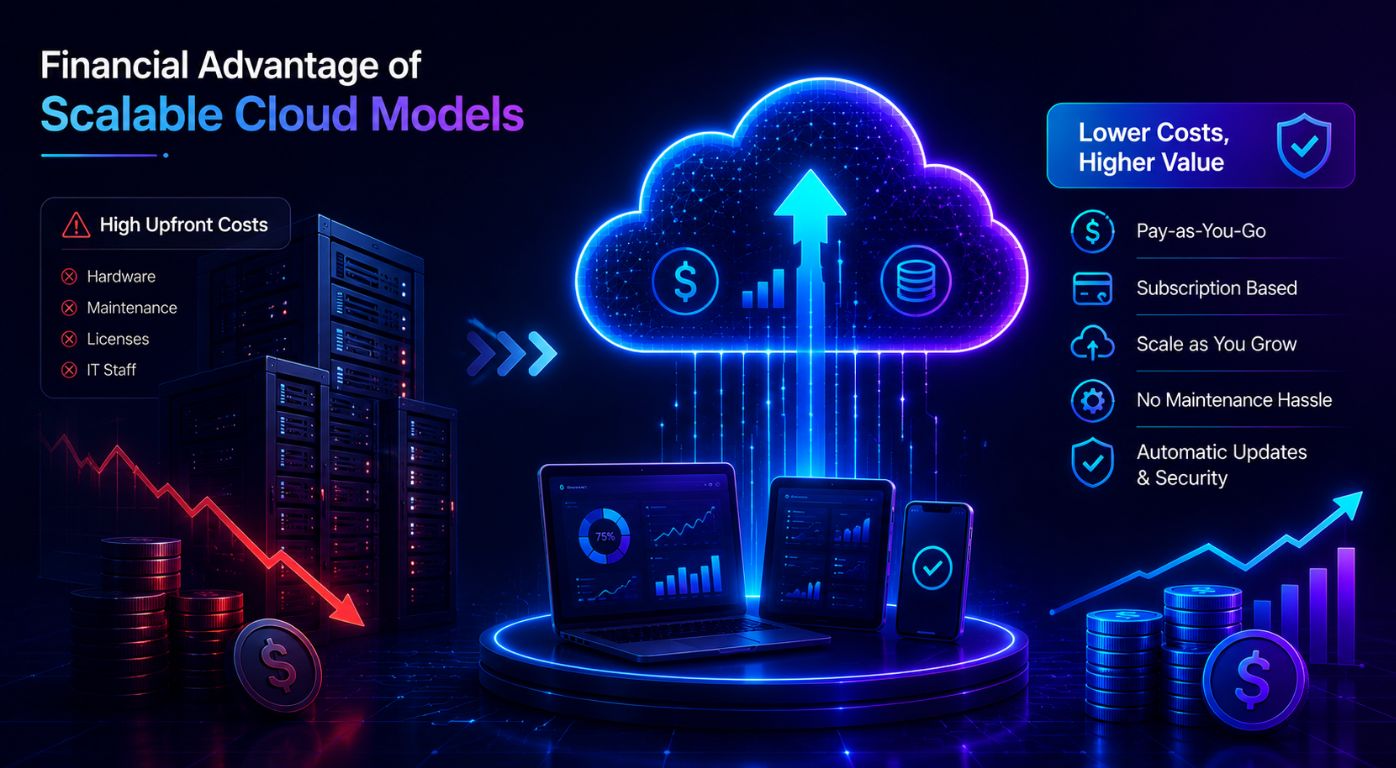
Investing in on-premise infrastructure can be exhaustive. Small businesses and startups usually cannot afford such expensive hardware. On-premise infrastructure comes with maintenance, software licenses, and a dedicated IT staff to manage the systems. In the long run, these costs can add up quickly.
Cloud-based applications are operational expenditure (OpEx) instead of capital expenditure (CapEx). It allows businesses to avoid huge upfront investments. Cloud services work on pay-as-you-go models and subscription-based services. Thus, businesses can add or remove storage or services as they grow and evolve. This is especially valuable for businesses running complex business systems like an ERP software development company in India, where cloud deployment removes the burden of costly on-premise server management.
Operational Efficiency: Freeing the IT Team
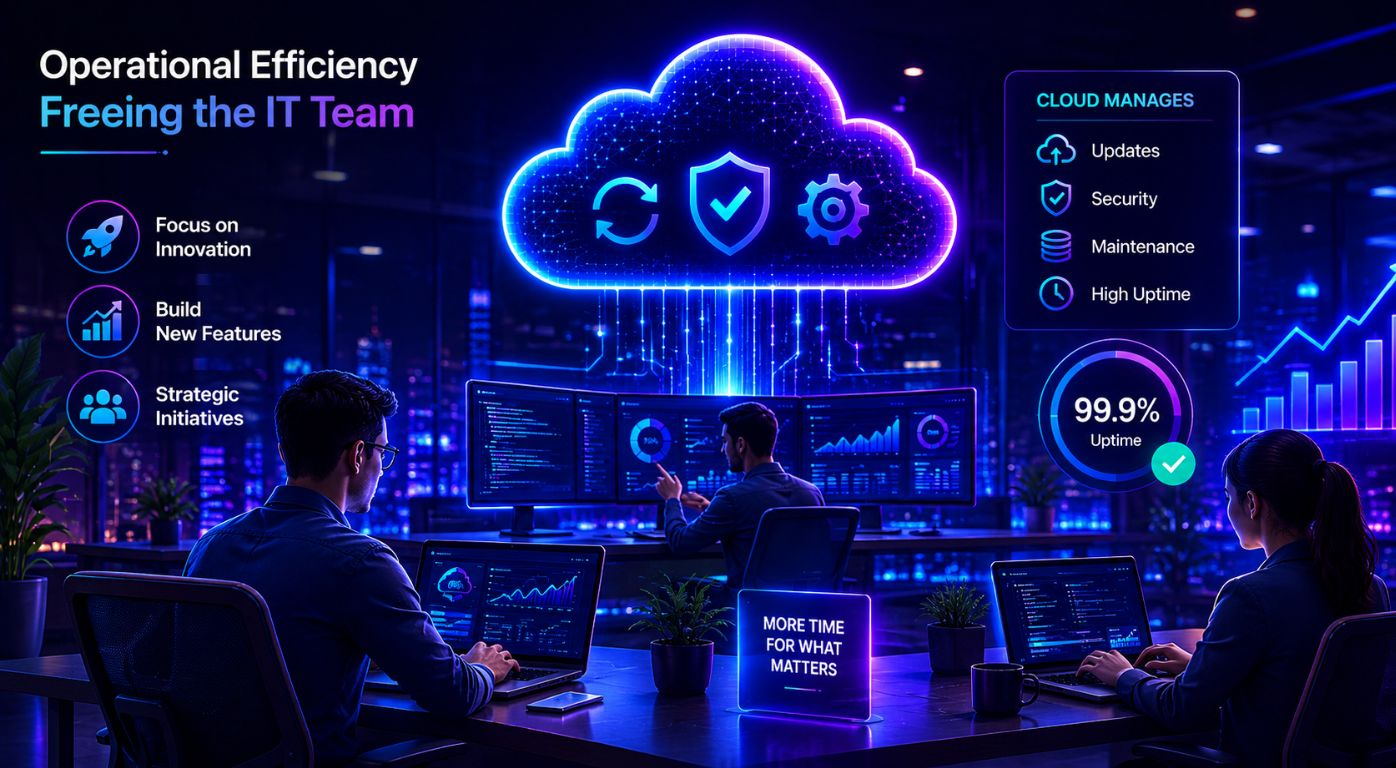
You would not have to assign your IT team to monitor or manage the on-premise infrastructure. They can focus on other important strategic initiatives and develop new features and products. It will also save you money as you would not have to hire dedicated specialists.
Cloud service providers will handle all the updates and maintenance, which makes it easier to scale, as you do not have to focus on those things. Many service providers guarantee 99% uptime, which means your IT team does not have to worry about outages or disruptions.
Conclusion
The world is evolving, and so are technology trends. As more industries start prioritizing efficiency and speed over establishing a hardware infrastructure, cloud-based applications are going to become the norm over the coming years.
They provide everything, from seamless collaboration and security to almost zero chances of disruption and easy scalability. Businesses looking to build scalable cloud-based products should also consider choosing the right SaaS architecture to ensure long-term performance and growth. By embracing this technology, businesses, small and big corporations alike, can stay ahead in the competition while providing the best services to their customers. Even companies for mobile app development in India have rapidly adopted cloud-based development for efficiency, speed, and cost-efficiency.
Ready to build? Contact Our Global Teams
🇺🇸 USA: +1 (919) 629-9671
🇬🇧 UK: +44 20 3581 6366
🇮🇳 India: +91 99099 84567
🇦🇺 AUS: +61 07 3121 3147

💬 Interested in Regular Insights on Software Development?
📲 Follow Shaligram Infotech on LinkedIn
Let’s build the future of applications together.
FAQs
What are cloud-based business applications?
What are cloud-based business applications?
Cloud-based business applications are software solutions hosted on remote servers and accessed through the internet. They help businesses manage operations, data, collaboration, and customer interactions without relying heavily on expensive and inefficient on-premise infrastructure.
How do cloud applications help businesses scale faster?
How do cloud applications help businesses scale faster?
Cloud applications allow businesses to instantly increase or decrease computing resources based on demand. This flexibility helps companies handle growth, seasonal traffic spikes, and expanding operations without investing time and money in expensive hardware.
Are cloud-based applications suitable for small businesses and startups?
Are cloud-based applications suitable for small businesses and startups?
Yes, cloud-based applications are perfect for small businesses and startups because they reduce upfront infrastructure costs. Cloud service providers have pay-as-you-go pricing models. This makes advanced technology more accessible and affordable.
Can cloud-based systems improve remote team collaboration?
Can cloud-based systems improve remote team collaboration?
Absolutely. Cloud applications enable employees to access files, tools, and systems from anywhere with an internet connection. This improves collaboration, communication, and productivity across distributed teams.
How secure are cloud-based business applications?
How secure are cloud-based business applications?
Most cloud service providers offer advanced security features such as data encryption, regular backups, multi-factor authentication, and automatic security updates. However, we recommend that businesses still follow best practices for data protection and access management.
What industries benefit the most from cloud scalability?
What industries benefit the most from cloud scalability?
Industries with fluctuating demand or rapid growth, such as eCommerce, healthcare, finance, education, logistics, and SaaS companies, benefit greatly from cloud scalability. It allows them to quickly adapt to changing workloads and demands.
What is the difference between cloud scalability and cloud elasticity?
What is the difference between cloud scalability and cloud elasticity?
Scalability refers to the ability to increase or decrease resources to support long-term business growth. Elasticity focuses on automatically adjusting resources in real time based on short-term workload fluctuations.

 Get In Touch