

Mobile App Development
Mobile Apps vs Web Apps Explained

GEt in Touch
| Table |
|---|
The custom software development choices made at the beginning of a product’s lifecycle often determine the efficiency of a business in growing and scaling. Among the most crucial decisions founders and product leaders encounter is whether to go for a mobile app or a web app. Although both options are valid, picking the wrong platform too soon can lead to increased expenses and delayed launches.
This blog post addresses the distinctions between mobile applications and web applications from the perspective of a top mobile app development company in India, directing both startups and large companies toward making decisions that align with their objectives.
Custom Software Development: Choosing Between Mobile Apps and Web Apps

The selection of a mobile app or a web app is not a decision based on technology first; it is a decision based on business strategy. Mobile apps are installed on user devices and are developed for repeated, personalized interactions. The web applications run on browsers, and their focus is on accessibility, speed of deployment, and cross-platform compatibility.
From the point of view of custom software development, web apps are generally the choice for early-stage products that allow businesses to test their ideas quickly with little friction. Mobile apps are usually the ones that come into the picture when the product has been developed to a certain level that requires deep user engagement, device-level features, or frequent interactions. It is very important to know how users will be accessing and interacting with the product before a decision is made regarding either approach.
Development Cost: Mobile App vs Web App

Cost of Development for Web Applications
Web applications usually need less investment at the beginning because users of different devices and operating systems can use the same application. Developers only have one codebase to manage, which cuts time for engineering tasks and simplifies testing. The updates and new features can be released at the same time for all users, and no user action is required, thus making the maintenance costs remain stable.
Web applications are a great choice for startups and businesses that are still validating their ideas since they are cost-effective, while the flexibility to change according to the feedback is still available. In addition, cloud infrastructures allow for controlled scaling without the need for significant upfront investments.
Cost of development for Native Mobile Applications
The development of native mobile applications involves the creation of different applications for various platforms, such as iOS and Android. Each platform possesses its own development environment, design guidelines, and testing processes. This results in the need for greater effort, more time, and higher costs in the development process.
Besides the actual development, companies must also budget for app store fees, compliance obligations, device testing, and continuous updates necessitated by operating system changes. Read this article on the cost of mobile app development. Mobile applications, in general, require a much bigger investment. To manage these costs without sacrificing quality, many strategic founders choose to hire mobile app developers from India. Despite the higher initial outlay, apps often turn that investment into profit when high engagement, offline access, or device integration become the core value of the product.
Web App vs Mobile App Cost Comparison
To give a better understanding of cost implications, the upcoming table illustrates the comparison of web apps and mobile apps from the viewpoint of custom app development. Even though the real costs depend on the development scope and complexity, such comparisons depict the most common industry situations.
| Cost Factor | Web Application | Mobile Application |
|---|---|---|
|
Initial development cost
|
Lower due to a single browser-based codebase |
Higher due to platform-specific development |
|
Design complexity
|
Moderate with responsive layouts |
High with device-specific UI/UX |
|
Development timeline |
Shorter and faster to launch |
Longer due to multi-platform builds
|
|
Maintenance effort |
Easier with centralized updates
|
More complex with app store submissions
|
|
Update deployment
|
Instant for all users
|
Requires user downloads and approvals
|
|
Long-term cost impact
|
More predictable and scalable
|
Increases with OS and device changes
|
Time-to-Market: Which Gets Your MVP Live Faster?
Web Application Development Timeline
Web applications are usually quicker in getting to the market as the development teams can just work on the main features without caring about the limitations of specific platforms. Testing environments are not as complex, and deployment does not require the approval of third parties. Right after the app is live, users can immediately reach it via a browser.
For the majority of MVPs, businesses can go from idea to launch much faster with web applications.
Mobile App Development Timeline
Mobile applications necessitate the extra development cycles for platform compatibility, comprehensive device testing, and app store reviews. Even the smallest updates must go through the approval processes, which can delay iteration. The use of cross-platform tools helps to cut down on timelines; however, mobile development is still much longer compared to web applications.
Web apps are the obvious choice for businesses that focus on quickness.
User Retention & Engagement: Where Do Users Stick Longer?
Mobile Apps: High Retention, High Commitment
Mobile applications usually have a higher retention rate compared to other platforms as they are always present on the user’s device and provide personalized communication. Push notifications along with offline capabilities and smooth operation invite users to come back again. Generally, the users who have the app installed show more intent; thus, mobile apps are perfect for the products that need regular interaction.
Sectors like Fintech, healthcare, and on-demand services depend heavily on mobile apps for cultivating long-term user relationships.
Web Apps: Lower Friction, Easier Access
The web apps get through installation requirements and so they are very accessible. Users can instantly access them through a link, which greatly increases their reach and at the same time reduces the friction for the user. This is the reason why web apps are preferred for use on occasional or broad audience platforms.
Nevertheless, if users are not present on their devices all the time, the web apps will have lower retention rates than mobile apps unless strong re-engagement strategies are in place to support them.
Technical Performance vs Practical Performance
Native Mobile Application Performance
Performance-wise, native mobile applications are superior since they directly engage with the hardware of the device. This is a critical distinction in the native vs cross platform apps debate, as native builds deliver quicker response times, more fluid animations, and better accessibility to sensors, cameras, and offline storage. Applications that require complex interactions or real-time processing thrive on this native performance.
Browser-Based Web Application Performance
The performance of modern web technologies is as good as that of most business use cases. Nevertheless, web apps are limited in their performance by the conditions of the network and the capability of the browser, which is problematic, especially in interactive scenarios. Web apps are perfect for dashboards, SaaS platforms, and portals, while they are still not as responsive as native mobile apps in case of resource-consuming tasks.
Scalability & Maintenance: What Happens After MVP Success?
Scaling Web Applications
Scaling web applications is generally easier since updates are deployed through a central system, and infrastructure can be extended using cloud services. Features can be rolled out, performance optimized, and security updated instantly without disrupting the user experience.
Scaling Mobile Apps
Mobile applications are capable of scaling up to millions of users, but the maintenance gets complicated as the updates have to be delivered through the app stores. Compatibility with various OS versions and devices results in long-term overheads that make scaling more resource-intensive than web applications.
Web App or Mobile App for Startup MVP?

When a Web App Is the Better MVP Choice
Web apps are perfect when the aim is quick validation, managing the budget, and having flexibility. Such platforms provide a range of functionalities for startups to conduct the whole process of feature experimenting, collecting opinions, and changing direction without having to pay for a very expensive development process.
When a Mobile App Makes More Sense
Mobile applications tend to be more appropriate for MVPs relying on the characteristics of the device, the availability of offline access, or the need for real-time interaction. If the main benefit of the product cannot be communicated through a browser, developing a mobile app might be a reasonable approach.
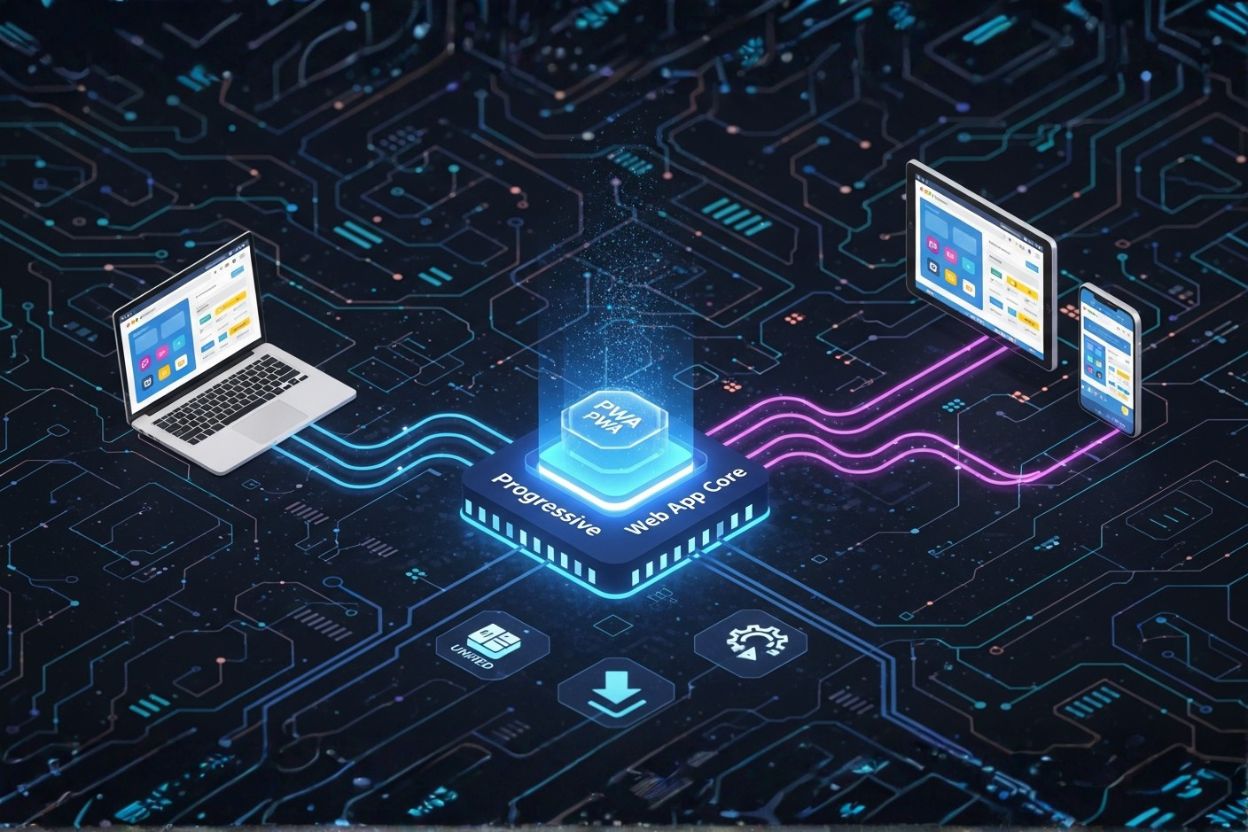
Progressive Web Apps for Startups: A Cost-Effective Middle Ground
Scaling web applications is generally easier since updates are deployed through a central system, and infrastructure can be extended using cloud services. Features can be rolled out, performance optimized, and security updated instantly without disrupting the user experience.
Why Progressive Web Apps Are Popular for Startups
PWAs, or Progressive Web Apps, are browser-based apps that are like native ones, and they come with features such as offline access and push notifications. Besides, these apps are developed at a faster rate and less cost than that of native mobile apps, thus becoming a suitable option for startups that want a gradual approach.
When PWAs Are NOT Enough
PWAs could be inadequate in situations where the applications require close hardware integration, very good graphics, or high-performance animations. In such cases, native mobile development will still be the best choice.
Decision Matrix: Mobile App vs Web App for Business
The decision to go for mobile or web applications is mainly based on business priorities. Web apps will give you speed, accessibility, and cost efficiency while mobile apps will give you engagement, performance, and user loyalty. By aligning your choice of platform with the product goals, you are guaranteed sustainable growth.
How to Choose the Right Custom Software Development Approach
- Identify the main issue for your primary user
- Grasp users’ actions and gadgets
- Establish a feasible budget and timeframe
- Rank MVP educational objectives
- Think about the possibility of expansion for future
Our Shaligram team partners with organizations to ensure tech choices are in sync with actual business results.
Common Founder Mistakes When Choosing Between Mobile and Web Apps
A lot of startup owners dive into mobile app development without first checking if there’s any demand. They also fail to factor in the maintenance costs while making the choice of platforms and tend to base their choice on the current user trend instead. All these errors lead to later launches, bigger budgets, and poor adoption.
Conclusion
There is no absolute answer to the question of whether mobile apps or web apps are better. On one hand, web applications provide speed, flexibility, and lower prices which make them suitable for MVPs and testing in the early stages. On the other hand, mobile apps ensure higher user engagement and performance, so they are considered a necessity when the product has already attracted demand.
At Shaligram Infotech, we are a software development company with a team of mobile app developers always ready to assist companies in selecting platforms based on strategies, scalability, and actual usage, thus guaranteeing that each product is constructed for long-term success.
Ready to build? Contact our global teams:
📧 Email: info@shaligraminfotech.com
🇺🇸 USA: +1 (919) 629-9671
🇬🇧 UK: +44 20 3581 6366
🇮🇳 India: +91 99099 84567
🇦🇺 AUS: +61 07 3121 3147
💬 Interested in Regular Insights on Web App Development?
📲 Follow Shaligram Infotech on LinkedIn
Let’s build the future of applications together.
Let’s build the future of applications together.
FAQs
What is the difference between mobile apps and web apps?
What is the difference between mobile apps and web apps?
Mobile apps must be installed on the device and utilize native hardware functionality. In contrast, web apps run in a browser, allowing users to access them without installation.
Mobile app vs web app for MVP: Which is better?
Mobile app vs web app for MVP: Which is better?
MVPs are usually best done in the form of web apps on account of quicker development and cost efficiency.
Web app or mobile app for a startup with a limited budget?
Web app or mobile app for a startup with a limited budget?
A web app is commonly the least costly option.
Are progressive web apps good for startups?
Are progressive web apps good for startups?
Absolutely, PWAs are characterized by app-like capabilities but come with a more reasonable development cost.
Which has a lower development cost: a mobile app or a web app?
Which has a lower development cost: a mobile app or a web app?
Web apps typically require lower initial investment and lower ongoing maintenance costs.
Can I start with a web app and build a mobile app later?
Can I start with a web app and build a mobile app later?
Yes. This is a phased approach that many successful startups have adopted.
Which option offers better user retention?
Which option offers better user retention?
Mobile apps are typically more successful in retaining users because they utilize native features for engagement.


 Get In Touch