
Mobile App Development
Native vs Cross-Platform Mobile Apps: Which One is Ideal?
GEt in Touch
| Table |
|---|
Mobile apps are central to customer engagement and business growth. Choosing the right development approach can decide a product’s success. As the global mobile app market continues to expand (expected to reach USD 626.39 billion by 2030), users now expect faster, smoother, and more secure experiences.
Businesses need apps that perform well, offer great UX, and deliver strong ROI within time and budget. Partnering with a custom mobile app development company in India helps achieve this through skilled talent and cost-effective solutions
The two main methods are Native and Cross-Platform app development. Each offers unique advantages based on your goals and audience.
This blog explains their pros, cons, and differences to help you choose the best approach for your next mobile app project.
What is Native App Development?

Native app development is the process of building apps specifically for one OS: Android or iOS. Using the OS’s own programming languages and development environments, developers construct their applications:
- iOS Uses: Swift or Objective-C, functionally using Xcode.
- Android Uses: Kotlin or Java, functionally using Android Studio.
Since such applications utilize the native tools and frameworks of the platform, they very closely integrate the features of the device, such as the camera, GPS, push notifications, and sensors. Direct access lets us have excellent performance, outstanding responsiveness, and platform-consistent UI/UX. If you are planning to hire a dedicated Android developer or a dedicated iOS developer for one‑platform optimization, native development gives you complete control.
Apps like Spotify, Instagram, and WhatsApp are the ones that are the most used, and they are all native-built and make use of the native APIs to provide users with perfect multimedia experiences, fast and fluent navigation, and development of interaction in real-time. Native apps use platform-specific languages and environments, like Swift for iOS and Kotlin for Android. If you’re considering building a native app, you can read more about the technical differences in Android Vs iOS App development.
Centralized Guest Database
Better Performance
Native applications are compiled directly into machine code specific to their respective platforms, thus removing the performance bottlenecks that are usually caused by the abstraction layers. They can perform very smoothly and process complex animations, graphics, and big data operations without any difficulties.
This is a reason why the native option is the only one for applications where speed and responsiveness are the main criteria, such as gaming, video streaming, and financial platforms, where even a tiny delay can affect user experience.
Better User Experience
Native development gives the designers the chance to be in perfect sync with each platform’s user interface guidelines – for Android, it is Google’s Material Design, and for iOS, it is Apple’s Human Interface Guidelines.
It is like providing users with a consistent, intuitive, and familiar experience. The buttons, gestures, and layout behaviors feel nice and smooth, like the very nature of the respective operating system, which results in user satisfaction and a less steep learning curve.
Enhanced Capability
The scalability of Native apps is remarkable; their capability to adjust available resources based on business needs is also tremendous. Developers can, without any performance or compatibility issues, create new modules, integrate APIs, or even system functions.
Moreover, the applications manage large numbers of users, multiple sessions, and complicated backend connections simultaneously, which makes them the best fit for big corporations and long-term growth plans.
Ease of Maintenance Stability
Native apps are powerful in the area of support from both the vendor and the community. Apple and Google give the developers regular SDK updates, performance improvements, and security patches.
Thanks to this, the applications are guaranteed long-term usability, lower crash rates, and even a constant update with OS-level innovations such as biometric authentication, app widgets, and AI-driven services.
Better Customization
Native development provides complete command over the application in terms of its behavior and design. Developers can create very customized features that utilize the highest level of device capabilities – such as AR/VR, machine learning, or low-level hardware functionalities.
For example, a natively developed camera app that can tap into the full potential of the device’s lenses and sensors, resulting in a super professional and fast user experience. If you’re looking to create a highly customized and high-performance mobile app, it might be time to hire mobile app developers. Our developers bring specialized expertise to build native applications that take full advantage of the platform’s capabilities.
What is Cross-Platform App Development?

Cross-platform application development is all about the seamless running of apps on different operating systems, primarily iOS and Android, through the use of a single and shared codebase. For many businesses wanting to reach both iOS and Android quickly, the option to hire dedicated mobile app developers experienced in cross‑platform frameworks is a strong strategy.
Developers do not need to write different code for every platform; instead, they will make use of frameworks like:
- React Native (JavaScript)
- Flutter (Dart)
- Xamarin (.NET)
- Ionic (HTML, CSS, JavaScript)
The frameworks will compile or bridge the shared code into the native components, which will result in the apps being almost indistinguishable in terms of look and behavior from the native applications.
Companies are considering cross-platform development because of the advantages it offers in terms of speed, cost-effectiveness, and an established, broader user base without the need to have two development teams for two different platforms.
Notable companies that have gone for cross-platform technology are Airbnb, Pinterest, and Skype, whose experiences with these tools have always been high-quality user experiences alongside the company’s broad reach.
Key Benefits of Cross-Platform App Development
Code Reusability
Using a single codebase, developers have the possibility of writing once and deploying it everywhere. This not only cuts down on the amount of effort spent but also makes sure that the platform’s apps are all very similar to each other, and leads to shorter development periods.
In case a bug is found or a change in a feature is desired, it will only take an update that becomes visible on all platforms, which implies lower maintenance costs and fewer mistakes.
Consistency Across Apps
Cross-platform frameworks are the ones that support companies in providing their customers with the same experience, no matter what device they are using. Users who move from one device to another are less likely to get confused because of the brand’s consistency and the simplified user journey.
Faster and Cheaper
The time and money for developing two separate native apps can be equal to that of one native app multiplied by two. Cross-platform frameworks help companies cut down on their development time by up to 50% while retaining the functionality that is still quite strong.
The said method is particularly advantageous for startups, small and medium-sized businesses, or any organization that wants to quickly launch an MVP (Minimum Viable Product) for market testing.
Enhanced Audience Reach
Simultaneous launch on iOS and Android platforms allows companies to connect with a larger user base instantly. This strategy enhances the visibility, the number of users, and the revenue potential from the very start.
Code Reusability
A shared codebase equates to one testing procedure only. The quality assurance (QA) teams can conduct the tests once rather than doing the same thing for every platform, which speeds up the release process and makes the product more reliable.
Key Differences Between Native and Cross-Platform App Development

Native vs Cross-Platform Mobile App Development: A Complete Comparison
Performance
Native applications, due to their close association with the platform, provide a degree of performance that is hard to beat, practically no lag at all, plus they can communicate directly with the APIs. They can perform activities demanding a lot of system resources, like 3D graphics, videos, and vast amounts of data interaction, and at the same time, the user can be unaware of it.
Using cross-platform apps, although there is a gradual improvement by means of technologies like Flutter’s Skia engine or React Native’s bridge architecture, there is still a little bit of overhead. Learn more about its capabilities in Flutter Docs. For regular applications, the difference will be hardly noticeable to users; however, for the demanding apps, the native platform is still the winner.
Development Cost and Time
Native application development entails working with two separate codebases, thus increasing the number of developers, extending the timeline, and increasing the budget. Yet, it guarantees much deeper integration and stability that lasts for a long time.
However, cross-platform development streamlines the process and consequently lowers the costs, making it a good option for startups and businesses that want to be the first to the market and thus have speed as their main priority.
Scalability
The very nature of native apps makes them more scalable as each platform can be updated independently, thus taking care of the risks associated with large-scale updates. Also, they tend to be more compatible with new OS updates.
On the other hand, cross-platform apps can still scale, but the process is mainly dependent on the chosen framework’s abilities and the support from the community. Sometimes, the release of updates for frameworks is behind that for OSes, resulting in new features being a bit delayed.
Choosing the Best Approach for Mobile App Development

How to Choose Between Native and Cross-Platform Apps
If your application requires high interaction levels with the device type, a high UX level, a tightly integrated hardware aspect, or relies on large data volumes, handle it; make it a native app. If you are using limited resources and time to reach multiple platforms, a cross-platform approach will maximize your efficiency.
Key Considerations for Selecting Native or Cross-Platform Development
- Budget: Native applications come with a larger initial investment; cross-platform is more cost-effective.
- Timeline: It typically takes longer to develop a native product; instead, a cross-platform product will deliver faster time to market.
- App Complexity: If the application has a lot of complex interaction (AI, AR/VR, advanced APIs), native can be the best bet.
- Target Audience: A cross-platform app can be developed at once for the target audience on both Android and iOS.
- Future Scalability: Native will be the best approach for future growth of the product or complex updates.
TL;DR - Which is better?
If peak performance, advanced hardware access, or complex graphics matter, choose native. If speed to market and lower cost across iOS and Android are priority, choose cross-platform. For most MVPs and consumer apps, cross-platform delivers faster ROI.
Cross-Platform vs Native: Which Approach is Better for Your Mobile App?
Before you can make a choice, understanding each app type in terms of its benefits is essential.
Benefits of Native App Development
The native approach gives the best performance, a lot of stability, and a unique experience of the platform. Companies that prioritize offline functionality, data protection, and the factors mentioned above find this method more appropriate.
This also gives more room for the UI control to be set, so it is perfect for applications where the user experience is an aspect of competition.
Advantages of Cross-Platform Development
Cross-platform is king in terms of quickness and productivity. It’s an excellent option for startups or small and medium-sized enterprises that want to rapidly test their ideas and not spend much while reaching different user groups.
The modern frameworks have become so good that they can deliver near-native app performance; hence, they are a strong player in the majority of the mainstream app categories.
Difference Between Cross-Platform and Hybrid Apps
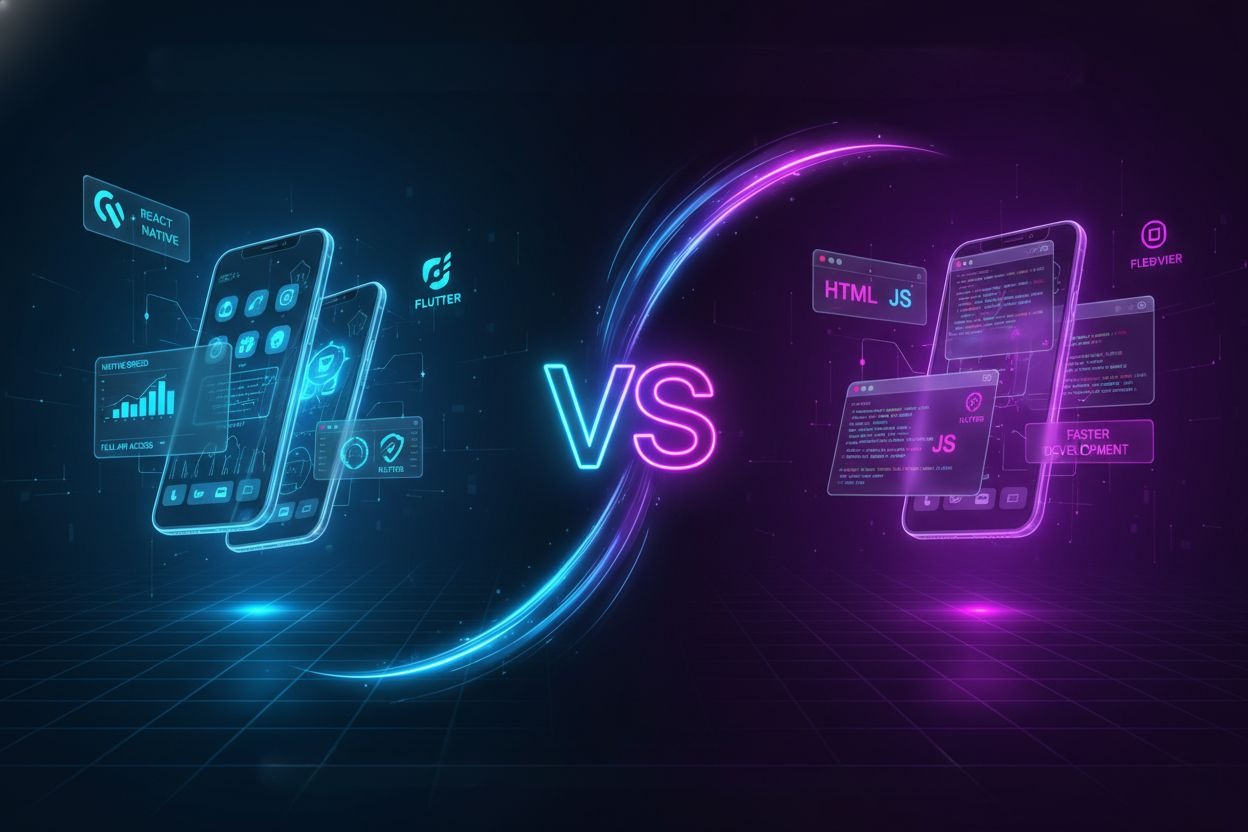
With so much buzz in the market surrounding the terms ‘cross-platform’ and ‘hybrid’, knowing how they differ from each other is key.
Cross-Platform Apps vs Hybrid Apps: What’s the Difference?
Even though they are frequently considered the same, there is a difference between them.
Cross-Platform Apps
Those are developed with the help of frameworks that turn the code into native binaries. They can run quite fast, and, at the same time, native APIs (like React Native, Flutter) can be used.
Hybrid Apps
They are nothing more than web technologies (HTML, CSS, JS) that have been embedded into a native wrapper and thus run within a webview. The development of these apps is faster; however, they are still usually slower and less responsive.
Besides that, hybrid apps can be used for content-heavy or simpler applications, but cross-platform apps come out as the better option for scalable, performance-driven mobile experiences.
When Should You Choose Native vs Cross-Platform for Mobile App Development?
Best Use Cases for Native App Development
- AR/VR Applications
- Enterprise Applications
- Audio & Video Streaming
- AI/ML Applications
- Gaming Applications
- ECommerce Applications
Best Use Cases for Cross-Platform App Development
- Social Networking Applications
- E-Learning Systems
- Utility Applications
- Startups and Minimum Viable Products
Conclusion
Both Native and Cross-Platform App Development methodologies offer significant advantages.
If you value performance, scalability, and long-term extensibility, native development is the safer bet.
If you value development speed, budget, and broad usability, cross-platform frameworks are your friend.
At Shaligram Infotech, our skilled developers work in both native and cross-platform technologies and map them back to business needs, helping businesses build beautiful, user-friendly apps with high performance. Whether you’re building an MVP or a fully-fledged enterprise-grade solution, our team will help make sure your app does something special; it’s built to be an agile powerhouse and prepared for new technologies for ever-expanding features. Partnering with the best software development company in India gives you access to the entire lifecycle, from strategy and design to deployment and post-launch support.
💬 Want regular insights on mobile app development?
Follow Shaligram Infotech on LinkedIn
Let’s redefine guest experiences with smart technology.
FAQs
What is the difference between native and cross-platform mobile app development?
What is the difference between native and cross-platform mobile app development?
Native applications are developed specifically for one operating system in its official programming languages, while cross-platform applications use a single codebase that can be executed over multiple operating systems. Contact us to choose the best approach for your mobile app development project.
Which is better for mobile app development: native or cross-platform?
Which is better for mobile app development: native or cross-platform?
For complex applications that require high performance, native is the best option. If you are a business and your priorities are to have a broader reach and a faster time-to-market, then expect to develop your app as a cross-platform app.
What is the difference between cross-platform and hybrid app development?
What is the difference between cross-platform and hybrid app development?
Cross-platform applications compile down to native code, while hybrid applications are built as code and run as a web-based approach within a native shell.
How does React Native compare to native app development?
How does React Native compare to native app development?
React native provides a faster time to market, a lower cost, and performs natively, while native applications give developers complete control and optimization.
How does Flutter compare to native app development?
How does Flutter compare to native app development?
Flutter offers faster development, a single codebase for multiple platforms, and near-native performance, while native app development provides greater flexibility, platform-specific optimization, and deeper integration with device features.


 Get In Touch