

Mobile App Development
Why Native App Development Still Delivers the Best User Experience

GEt in Touch
| Table |
|---|
In a digital world, mobile applications have become the front lines of customer interaction. Users intrinsically expect whatever app they are using to be fast, friendly, and entirely consistent with how their device is designed. Although cross-platform tooling options such as Flutter and React Native may offer improved speed and lower costs, developing applications natively is still very much the gold standard for superior user experience (UX).
This demand has also contributed to the rapid growth of mobile app development in India, where businesses increasingly prefer native apps for long-term reliability and performance.
For businesses seeking high performance, scalability, long-term sustainability, and brand trust, understanding why native apps offer a superior user experience is essential. The purpose of this article is to explain the key components of native development, the differences between iOS and Android platforms, and why native offers better performance, reliability, and satisfaction as compared to other options.
What Is Native App Development?

Native mobile application development is the building of apps for one mobile operating system, iOS or Android, in the OS platform-specific programming languages, using the development environment that the platform specifies.
- iOS development relies on Swift (and the modern SwiftUI framework) within Xcode.
- Android development primarily uses Kotlin (and Jetpack Compose) inside Android Studio.
Unlike native apps, hybrid or cross-platform approaches utilize one codebase and additional layers to translate before the app runs, meaning they cannot interact with the device hardware and OS APIs directly. When native apps speak directly to device hardware and the OS APIs, performance is generally faster, animations are smoother, and the interfaces simply feel more natural when engaging with the app.
iOS Development
Native iOS apps are made for the complete Apple ecosystem: iPhones, iPads, and Apple Watches. To create this seamless experience, developers utilize Swift and SwiftUI alongside Apple’s Human Interface Guidelines (HIG). This ensures that navigational patterns, font scaling, and animations behave exactly as loyal iPhone users expect. Many businesses also choose to hire iOS app developers in India to build high-quality native iOS apps that align perfectly with Apple’s design and performance standards.
The major UX benefits of the native iOS approach are:
- Close integration with the use of SiriKit, ARKit, HealthKit, and Face ID
- The compatibility with features such as haptic feedback, widgets, and gesture-based navigation
- High performance throughout Apple’s highly regulated device ecosystem
Each aspect, including animations and touch responses, is made to suit the hardware and software of iOS perfectly. As a result, a smooth and coherent experience is produced that matches the expectations of the users perfectly.
Android Development
Native Android applications are done with Kotlin or Java, and that too by following Google’s Material Design for aesthetic uniformity. Android programmers get the chance to explore more through Jetpack and Google Play Services, which are already equipped with loads of APIs and libraries; hence, creating applications with great personalization and extensibility is easier. Because of this flexibility and deep ecosystem support, many businesses prefer to hire Android app developers in India to build scalable and highly customized native Android apps.
The User Experience that Android native development offers contains:
- Specific experiences for all possible screen sizes and resolutions
- Strong connection with Google Maps, Firebase, and Play Billing
- Plenty of customization and adaptive UI layout possibilities
- Smart controlling of background activities, notifications, and data synchronization
It is native development that allows Android applications to deliver swift responses and different types of experiences, at the same time across various kinds of hardware.
Why this matters for UX
The perfect UX is not only about the aesthetics of an app, it is also about the experience it provides. The user will rate the product based on responsiveness, reliability, and intuitiveness. Native apps have the following advantages:
They…
- Mount the fastest performance using platform-specific APIs.
- Immediately give any feedback to the user’s actions.
- Keep the same UI patterns that the users are familiar with.
- Take away the offline unreliability and provide smooth data synchronization.
All these things combined to make native apps seem like a part of the user’s natural environment, and they operate without any effort on the user’s part; these are the most important factors in users’ retention and happiness.
Key Benefits of Native App Development (UX-First)

Super-Speed Performance
Because native applications work directly with the operating system through compiled code, they enjoy speedy load times.
Smooth UI and Animations
The rendering engine is fine-tuned for the GPU of the device, which results in quick and soft transitions as well as touch responses.
Consistent User Experience Over Different Platforms
The design of every UI component corresponds to the principles of the respective platform design standards, such as Apple’s HIG or Google’s Material Design.
Functionality without Connectivity
The use of native caching and local storage APIs makes it possible for apps to be very effective even in the absence of an internet connection.
Top-notch Security
The use of secure APIs like Keychain, Secure Enclave, and SafetyNet for integration guarantees data security.
Long-Term Scalability
Native architectures easily adapt to the new operating system features and the changes in business requirements.
Advantages of Native Mobile Apps (vs Alternatives)
Three factors, like Performance, Development Cost & Time, and Scalability, have to be considered when you compare native apps and cross-platform or hybrid methods.
Performance
Native applications provide the ultimate performance due to the fact that they are executed right on the operating system without any middleware or code translation. It guarantees:
- Faster startup times
- Stable frame rates
- Lower battery consumption
- Fewer crashes
While cross-platform frameworks are improving, they rely on non-native rendering engines or communication bridges (like the JS bridge in React Native). These abstraction layers can introduce latency, causing “jank” in complex animations that native code handles effortlessly. Thus, if an app is dealing with real-time interactions, 3D graphics, AR/VR, or video processing, then native performance is definitely the best option.
In the end, the smoother the app, the stronger the emotional users’ connection, and that’s the area where native development excels.
Development Cost & Time
Cross-platform frameworks claim that sharing the same code for both iOS and Android would result in quicker delivery to market. But, in the long run, native apps might have better cost efficiency.
Here are the reasons:
- Maintenance hours are cut down as the native app faces fewer bugs that are unique to the platform.
- With OS releases, updates are rolled out more accurately.
- Native frameworks decrease reliance on third-party plugins, resulting in smaller technical debt.
Investing money at the beginning may be higher, but the total cost of ownership (TCO) of the app during its lifetime is usually lower, particularly for apps that need constant updates, high UX quality, or advanced integrations.
Scalability
Scalability is not only measured by the number of users but also by the application, creating no hassle for the users as it becomes more complicated. So, native architectures can scale up effectively by doing the following:
- They can take advantage of multithreading and background services.
- Integration with various cloud platforms such as AWS, Azure, and Firebase is hassle-free.
- They can adopt a modular development approach and a microservices-based architecture.
Cross-platform frameworks sometimes cannot keep up with the demand for more features or changes in the OS, which often leads to the need for extra workarounds. On the contrary, native apps are getting better together with platform innovations, thus they are a future-ready investment.
App Performance in Native Apps
Native applications performed faster and smoothly as they were made with platform-dependent code, which was completely optimized for the device. They had direct access to hardware resources such as CPU, GPU, and sensors, which, besides eliminating the delays caused by cross-platform layers, also gave a faster load time. Such performance stability and even fluid animations during heavy usage were the result of the native applications.
Native APIs enabled developers to choose memory and caching in such a way as to provide an always responsive experience, one that feels easy for users and builds trust in the application’s quality.
Mobile UX: Why Native Apps Win
The user experience is connected to emotions, and the users relate the responsiveness, speed, and design quality to the brand’s trustworthiness. Native applications have a constant lead over others because they:
- React without delay to finger movements and words
- Render clean and lively pictures and transitions
- Combine perfectly with system gestures and haptics
- Keep the look and feel the same during updates
All these not so obvious but very important factors contribute to the app being alive, which in turn, user engagement, retention, and app store ratings, all become better.
iOS Development vs Android Development: What Changes for UX?
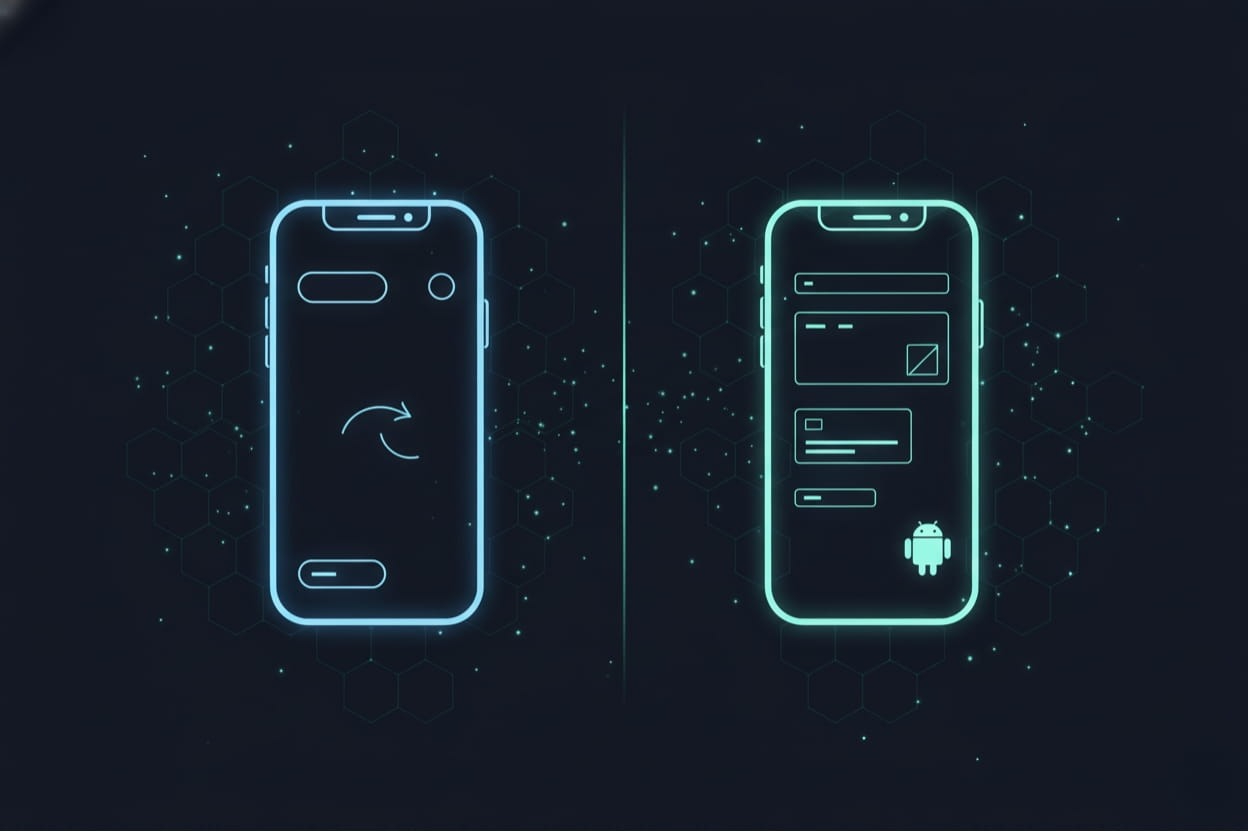
Although native development ensures both platforms provide excellent experiences, they are still separated by design philosophy and technical ecosystems.
1. Design Language
- iOS → clarity, depth, motion, simplicity
- Android → flexibility, customization, adaptable components
2. Ecosystem Control
- iOS → limited devices = consistent experience
- Android → many device types = customization with complexity
3. UX Outcome
- iOS → more uniform
- Android → more personalized
The best outcome is achieved when the successful applications adapt their UX strategy to every platform rather than impose a universal approach.
Cross Platform App Development: Pros, Cons & When It Fits
Cross-platform development comes with its pros and cons, especially around speed and code sharing. It is a good choice when:
- The project is an MVP or prototype
- The target audience is small or limited
- The performance of UX is still of no critical concern.
Nonetheless, cross-platform frameworks might not be able to deliver the same level of smoothness as native applications that need very high interactivity, offline performance, or even native-level animations. Companies have to decide if getting the product to market quickly or providing a top-notch user experience over the long haul is their primary concern.
Mobile App Performance Optimization (Native Playbook)
There is one thing to develop a native application and another thing to maintain its speed and efficiency. Developers use proven methods to keep the user experience performance at its best:
- Regularly profile using Xcode Instruments and Android Profiler.
- Reduce the number of layers drawn and layout complexity for faster rendering.
- Apply lazy loading techniques to reduce cold start times.
- Store assets so they are accessible without glitches during offline periods.
- Conduct A/B tests to refine interaction paths and increase customer retention.
Data drives these optimizations in native frameworks and can be measured directly, thus making sure that the UX grows alongside the user habits.
Mobile App Development Decision Framework (TCO & Roadmap)
Although native development ensures both platforms provide excellent experiences, they are still separated by design philosophy and technical ecosystems.
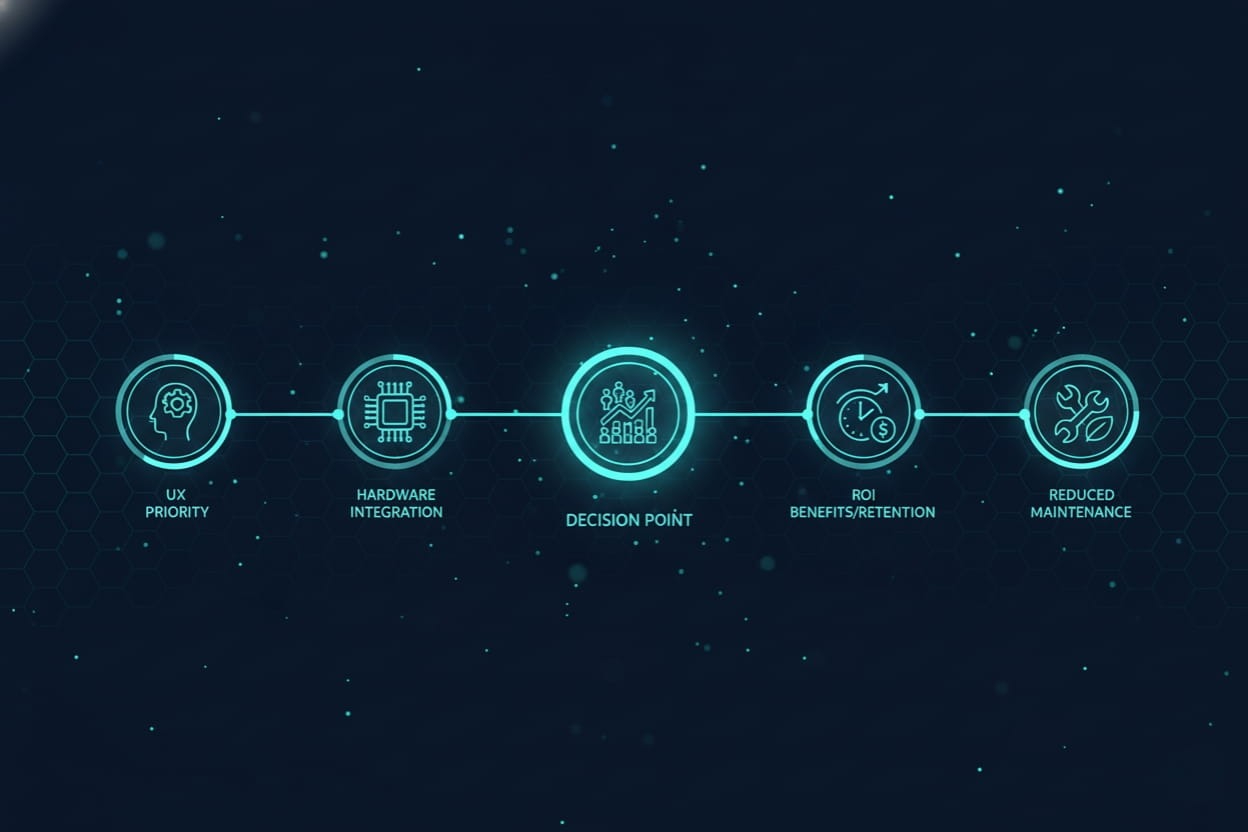
Choose native development when:
- UX is a core business priority
- You need advanced hardware integrations
- The app will scale to a large user base
- The product roadmap includes long-term updates
Native apps cost more early on but deliver better ROI through:
- Lower crash rates
- Higher retention
- Longer lifespan
- Fewer maintenance issues
Team Structure, Tools & CI/CD for Native Development
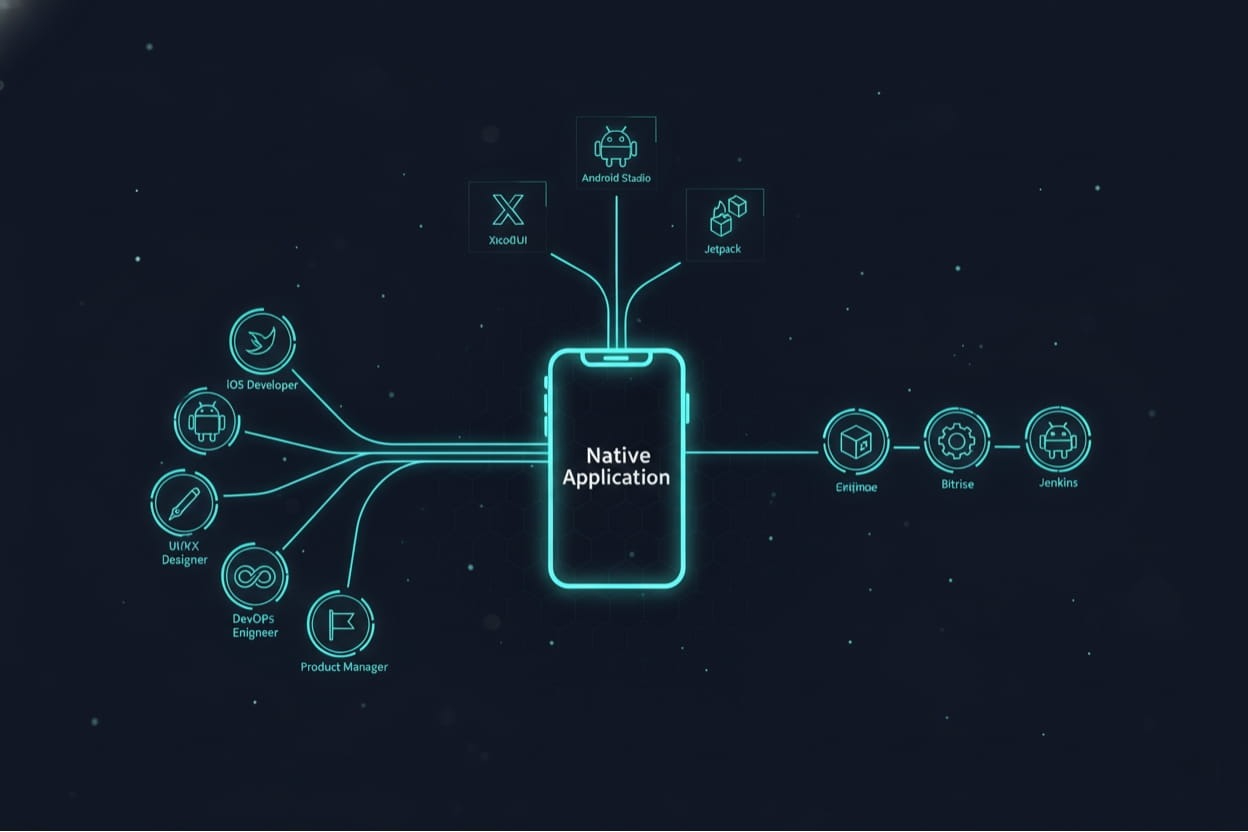
Team Needed
- iOS developers
- Android developers
- UI/UX designer
- QA engineer
- DevOps engineer
- Product manager
Tech Tools
- iOS: Xcode, SwiftUI
- Android: Android Studio, Jetpack, Firebase
CI/CD Tools
- GitHub Actions
- Bitrise
- Jenkins
These provide smooth releases and consistent app quality.
Conclusion
Cross-platform technologies are getting better, but native app development remains the ultimate standard for delivering the user experience users expect. It merges raw power, platform mastery, and artistic precision to produce intuitive, reliable applications that feel like a natural extension of the user’s device.
Shaligram Infotech brings this philosophy to every project, empowering Healthcare, Fintech, and E-commerce businesses with future-ready native solutions backed by our reputation as the best software development company in India. For companies that view UX as a competitive edge, native development is the proven strategy for long-term brand loyalty and growth.
Ready to build? Contact our global teams:
📧 Email: info@shaligraminfotech.com
🇺🇸 USA: +1 (919) 629-9671
🇬🇧 UK: +44 20 3581 6366
🇮🇳 India: +91 99099 84567
🇦🇺 AUS: +61 07 3121 3147
FAQs
Is native or cross-platform better for mobile UX?
Is native or cross-platform better for mobile UX?
The most incredible user experience is given by native apps through their very access to the hardware, OS-level APIs, and design guidelines that align with users’ expectations.
How do native iOS/Android features (widgets, haptics) impact user experience?
How do native iOS/Android features (widgets, haptics) impact user experience?
They not only make the app more interactive and immersive, but also increase the user’s connection to the app, thus improving the user’s joy and satisfaction.
How do native apps handle offline mode and sync more reliably?
How do native apps handle offline mode and sync more reliably?
Native application programming interfaces take care of the work and ensure the performance is not affected by the cache or sync operations.
What’s the long-term TCO difference between native and cross-platform?
What’s the long-term TCO difference between native and cross-platform?
The initial cost of native applications is higher, but the total cost of ownership is lower due to bugs, maintenance, and user retention being the factors.
Which KPIs prove a superior native experience (cold start, crash-free rate, frame time)?
Which KPIs prove a superior native experience (cold start, crash-free rate, frame time)?
- Cold start time
- Crash-free rate
- Frame time
- User satisfaction scores


 Get In Touch