Categories
Blog Microsoft
integrating-ai-machine-learning-smarter-operations-dynamics-365
Microsoft

Integrating AI and Machine Learning for Smarter Operations with Dynamics 365

Abstract AI and machine learning visuals integrated with business operations and Dynamics 365 elements

GEt in Touch


    The speed of digital transformation has never been so fast as now, and businesses are under immense pressure to improve operations and drive value for customers. Artificial Intelligence (AI) and Machine Learning (ML) have become integral to Microsoft Dynamics 365, helping businesses optimize processes, analyze data more effectively, and make smarter, faster decisions. By choosing Dynamics 365 services enhanced with AI and ML, companies can unlock greater value from their existing operations.

    Organizations can open up newer opportunities for automation, efficiency, and customer engagement with the application of AI in business, especially with Microsoft Dynamics 365. By leveraging Microsoft Dynamics 365 services, they can shift from being reactive to proactive by taking advantage of intelligence and taking the right action at the right time to tackle challenges with precision.

    Why AI and Machine Learning Matter for Modern Business Operations?

    Today, businesses use data to run their organizations. They get to generate meaningful information from each customer engagement, financial transaction, and operational process. However, it is not possible to get maximum benefit from data if it is not used correctly when using the right tools. This is where powerful tools like ML and AI for business operations are used to sift through large datasets, find hidden patterns, and get actionable insights.
    AI and ML capabilities can support an organization by providing predictive insights into customer behaviors, optimizing supply chain opportunities, and enabling data-driven, fact-based decision-making over intuition-based strategies. It is now imperative for organizations to embrace AI and ML technologies to remain competitive in these fast-growing markets.

    Integrating AI into Dynamics 365: What You Need to Know
    Visual of AI integration with Dynamics 365 using neural networks, data flows, and business app icons


    Microsoft Dynamics 365 provides built-in AI capabilities across Finance, Supply Chain Management, Sales, and Customer Service modules. This allows businesses to automate workflows, use predictive analytics for demand planning, and deliver highly personalized customer experiences, all from within the Dynamics 365 platform. Dynamics 365 AI integration offers capabilities not limited to data analysis but extending to intelligent automation, natural language processing, and advanced predictive modeling.

    Integration of AI begins with understanding organizational needs and aligning those needs with the AI-powered modules in Dynamics 365. This also involves considering data readiness, ensuring the data is clean, well-structured, and easily accessible, which enables AI to generate accurate results.

    How Microsoft Dynamics 365 AI Solutions Drive Business Growth

    Artificial Intelligence transforms Dynamics 365’s business solutions into intelligent business ecosystems. In Customer Engagement, for example, AI-driven chatbots can assist customers with simple inquiries, which provides the opportunity for agents to focus on high-level, complex cases. In Finance, anomaly detection tools that use ML help detect fraudulent activity, as well as identify any unusual expenses. In Supply Chain Management (SCM), AI predictions help organizations by proposing optimized inventory levels and identifying procurement and demand fluctuations.
    AI business solutions enhance functions to achieve strategic outcomes, while also automating simple tasks. Dynamics 365 serves as the foundation where AI enhances core processes by introducing smarter, faster, and more reliable decision-making capabilities, empowering organizations to make data-driven decisions with Dynamics 365 services.

    Benefits of AI-Driven Business Solutions in Dynamics 365
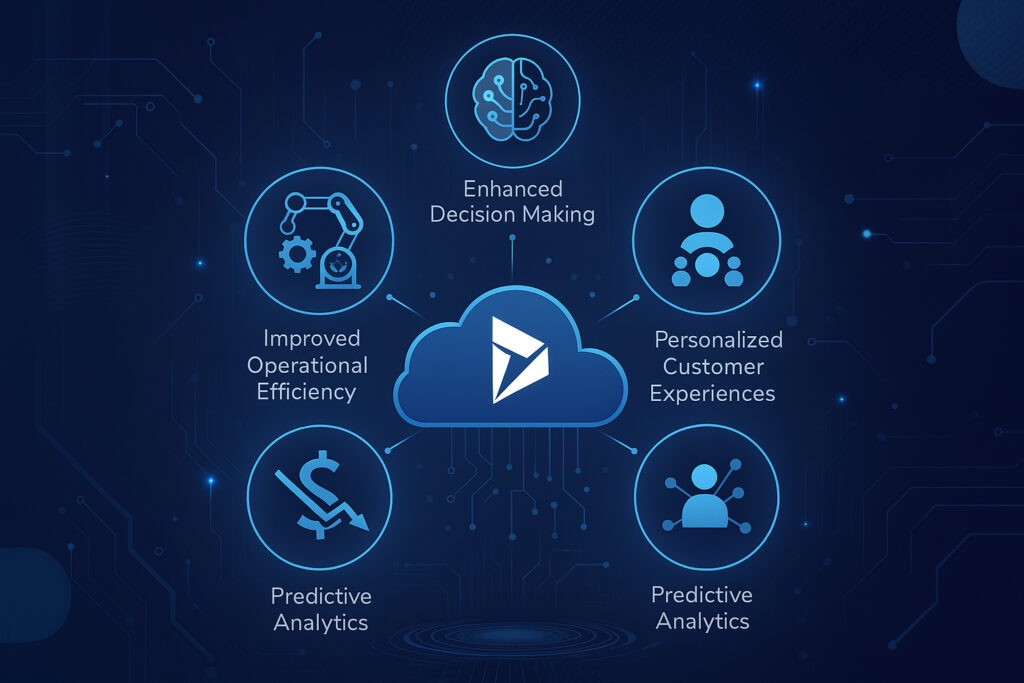
     

    The primary value of integrating Microsoft Dynamics 365 with AI and ML lies in its business applications. Companies need to improve operational efficiencies and innovate in customer interactions and business planning. By applying intelligence to day-to-day activities, Dynamics 365 helps organizations work with agility and resiliency. Let’s examine a few of those benefits more closely.

    Improved Operational Efficiency

    Artificial Intelligence in business, along with automation, helps lower the burden of manual processing within routine tasks so that employees can focus on high-value jobs. Dynamics 365 can help automate day-to-day functions that are repetitive, such as data entry, invoice approvals, time and service scheduling. This helps with faster process flow while removing chances of human errors, leading to efficient & smoother operations.

    Enhanced Decision Making

    Leveraging built-in AI for Dynamics 365 lets leaders make data-driven, informed decisions. Instead of waiting for reports on a monthly or quarterly basis, decision makers will have access to dashboards of data and predictive recommendations in real time. This lets organizations have the ability to spot trends, assess risks, and identify new opportunities quickly.

    Cost Reduction

    By integrating AI into Microsoft Dynamics 365, organizations can reduce operational costs through intelligent automation, predictive maintenance, and accurate demand forecasting. This ensures businesses maximize their Dynamics 365 investment while avoiding costly inefficiencies. Automated workflows contribute to reducing manual tasks, predictive maintenance reduces downtimes, and accurate demand forecasts can eliminate inventory spoilage. With time, these processes lead to effective cost reductions within organizations.

    Personalized Customer Experiences

    Customers today expect every interaction to be deeply personalized. Dynamics 365 with AI-based customer insights promotes customer satisfaction by letting businesses analyze customer preferences, gather customer feedback, and learn from user behaviors. Whether through customized marketing campaigns or unique service recommendations, AI can help businesses stimulate a deeper connection to their customer.

    Predictive Analytics

    AI-based predictive analytics in Dynamics 365 represents one of the more profound possibilities for organizations. Machine learning models assess historical data to predict future behavior, customer needs, and operational hurdles. By addressing these situations before they happen, organizations can prepare for market changes, reduce risk, and capitalize on opportunities before their competition.

    Machine Learning in Dynamics 365: Smarter Business Decisions

    Dynamics 365 Machine Learning models can go beyond providing simple analysis of data. They offer improved predictions and recommendations by continuously learning from new datasets. For example, historically, ML models have been able to predict leads with a high chance of converting into sales and check financial data for any warning alerts. Machine Learning helps businesses make more accurate and more intelligent decisions by refining their insights, thereby ensuring long-term strategic success.

    Streamlining Operations with AI and Automation in Dynamics 365

    AI-driven automation is a groundbreaking force for building operational workflows. Dynamics 365 enables businesses to automate case assignments to the appropriate agents, plan delivery routes, and streamline procurement approval processes, thus improving operations through Dynamics 365 business process automation.

    Overcoming Challenges in AI and Machine Learning Integration

    Even with this great potential, there are significant challenges to integrating AI and ML with Dynamics 365. This includes organizational data being in silos, as well as faulty and incomplete data, and overall company unpreparedness. Additionally, employees who fear their jobs will be replaced by AI will resist the change.
    Being successful at overcoming these potential barriers requires an effective change management plan, proper communication about the AI implementation role, and serious work on the data governance area. Apart from that, security and compliance considerations need to be taken into account to ensure sensitive data is used securely by AI models.

    Best Practices for AI and Machine Learning Adoption in Dynamics 365

    Organizations are required to follow best practices to derive maximum value from using AI and ML in Dynamics 365. Establishing clear objectives and setting them within the framework of actual business is one of the best practices rather than creating technology hype. Ensuring that your data infrastructure can accommodate AI and ML technologies is another key thing. You should also work towards training employees to work with AI tools, including the ability to interpret insights, which can be effective.
    Next, accelerate deployment and mitigate AI-related risks in business integration by partnering with experienced Dynamics 365 professionals like Shaligram Infotech. Finally, adopt a phased approach, starting with small AI-driven projects and then transitioning to large-scale initiatives. This approach enables organizations to build confidence and demonstrate a visible ROI for the business.

    Future-Proofing Your Business with AI and Dynamics 365

    Organizations that integrate AI and ML with Dynamics 365 can identify new opportunities for enhanced customer engagement and efficiency. As a leading software development company in India, we understand how it helps businesses understand customer needs, anticipate market shifts, and innovate as needed with confidence.

    Using AI to enhance business operations with Dynamics 365 involves challenges and requires thorough planning. However, those who can embrace them will be able to cope with the rapidly evolving digital space and ensure long-term growth for themselves. Get in touch with us today to explore how Dynamics 365 and AI can transform your business operations.