

Cloud Computing
Server-Side Rendering (SSR) v/s Client-Side Rendering (CSR)

GEt in Touch
| Table |
|---|
How a page is rendered directly impacts perceived speed, SEO, and user experience, which are critical factors in web application development services in India.
Client-Side Rendering (CSR): In CSR, the browser downloads a minimal HTML shell and runs JavaScript to build the user interface. This approach is excellent for interactive single-page applications (SPAs), but it requires additional work to optimize SEO and improve first-paint speed.
Server-Side Rendering (SSR): SSR involves the server returning fully rendered HTML for the initial request. This significantly enhances time-to-first-paint and boosts SEO for content-heavy pages, making it ideal for improving overall page load performance.
This article covers CSR, SSR, SSG, ISR, and ESR, providing practical examples, runnable code snippets, performance checks, and a developer checklist to help you determine the best approach for your web application project.
Web Page Rendering Methods
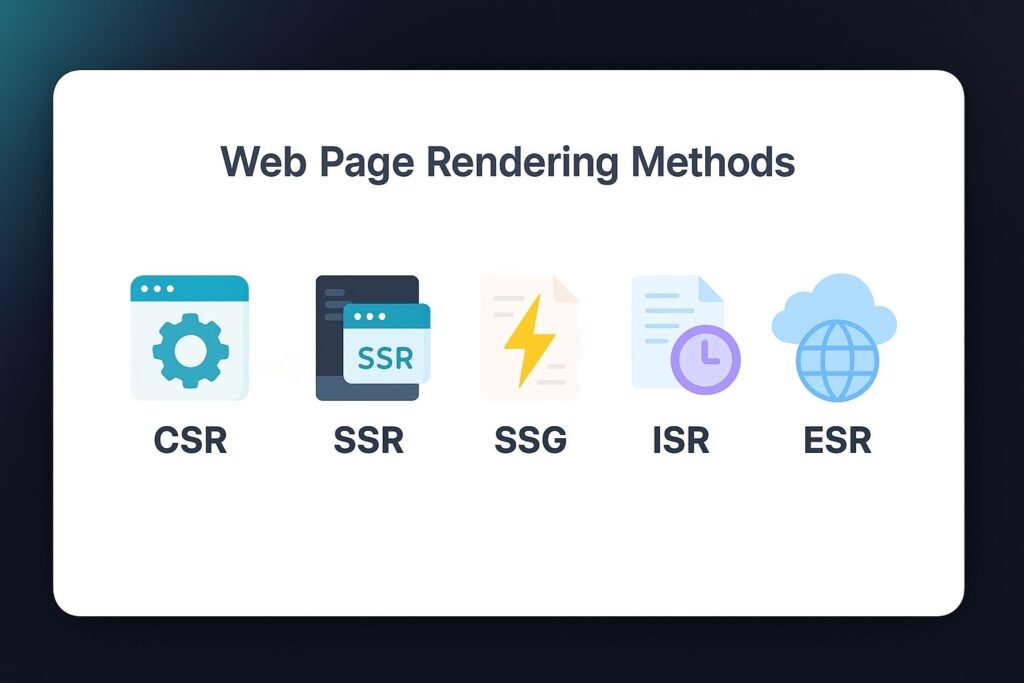
Rendering decides when and where HTML is produced. Short definitions:
- CSR (Client-Side Rendering): The browser downloads a shell and JavaScript bundles, and renders the UI on the client.
- SSR (Server-Side Rendering): The server returns fully formed HTML per request.
- SSG (Static Site Generation): Pages are pre-built at build-time and served as static files.
- ISR (Incremental Static Regeneration): SSG with on-demand/regenerated pages at runtime (e.g., Next.js revalidate).
- ESR (Edge-Side Rendering): Render near the user on edge nodes for low-latency dynamic pages.
What is Client-Side Rendering (CSR)?
CSR ships an HTML shell and JavaScript bundles to the browser; the browser then fetches data and renders the UI. CSR is ideal when runtime interactivity is primary.
Key Features
- Fast interactions after initial load (UI handled on client).
- Good for real-time updates, drag-and-drop, and complex stateful UIs.
- Initial load can be slower (JS parsing/execution).
- SEO requires pre-rendering, dynamic rendering, or server-side fallbacks.
What is Server-Side Rendering (SSR)?
SSR generates full HTML for each request on the server and sends it to the client. This improves first-paint and indexability.
Key Features
- Faster perceived initial load and better LCP for content pages.
- Predictable SEO: crawlers receive full HTML.
- Works better on low-end devices or slow networks (less client CPU).
- Requires server resources and a caching strategy (s-maxage, stale-while-revalidate) to scale.
What is Edge-Side Rendering (ESR)?
ESR runs rendering logic on edge nodes (Cloudflare Workers, Vercel Edge) to deliver dynamic HTML closer to users, reducing network latency.
Key Features
- Very low TTFB for users geographically distributed.
- Suitable for personalized pages that still need SEO-friendly HTML.
- Requires edge-compatible code and often vendor-specific APIs.
- Combine with CDN caching (s-maxage) and smart cache keys to scale.
What is Incremental Static Regeneration (ISR)?
ISR = SSG + on-demand regeneration. Pre-build pages and re-generate them at runtime using a `revalidate` window.
Key Features
- Fast, cached pages with near-real-time freshness.
- Lower server costs vs. full SSR for extensive catalogs.
- Ideal for blogs, product catalogs, and news feeds where instant real-time updates aren’t required.
What is Static Site Generation (SSG)?
During the build process, all HTML pages are prerendered by Static Site Generation. Pages are delivered as static assets, which, once built, result in lightning-fast performance.
Key Features
- High-speed (CDN-cached HTML).
- Simple infra and excellent scaling for read-heavy sites.
- Not ideal for highly personalized, real-time data without ISR or client-side fetches.
Client-Side Rendering vs Server-Side Rendering: Comparison
| Factor | CSR | SSR |
|---|---|---|
|
Rendering
|
Client (JS bundles)
|
Server returns full HTML |
|
SEO |
Medium (needs pre-render/dynamic rendering) |
High (HTML available to crawlers)
|
|
Initial load |
Slower (JS parse/exec) |
Faster perceived; better LCP
|
|
Interactivity
|
Excellent after load
|
Good with partial hydration |
|
Server cost |
Lower per-request
|
Higher (unless cached)
|
|
Use cases |
SPAs, dashboards, in-app editors |
Blogs, product pages, marketing sites
|
How to Choose the Correct Web Page Rendering Method?

Choosing a rendering method depends on several factors, including SEO, interactivity, content type, and infrastructure. The following factors are discussed:
SEO (as needs/priority)
If your site heavily relies on organic traffic, such as e-commerce sites, publishing/news sites, or blogs, SEO must be a priority. SSR, SSG, or ISR are better options since you get fully rendered HTML that can be crawled easily by Googlebot. Even though CSR can be SEO optimized, it will often take more work if you want proper results (like dynamic rendering, prerendering).
Website Functionality/User Value
Think about what is most important to your users. If they require high interactivity (e.g., dashboards, web apps, or chat platforms), CSR will be better, as it allows for dynamic updates in the browser. If your site delivers content as value to the user (e.g., blogs, portfolios, news), SSR, ISR, or SSG will provide better load times and improved readability.
Project Type (Dynamic vs Static)
Dynamic websites that undergo frequent changes or display personalized data, such as eCommerce product pages or booking sites, are a better fit for SSR, ISR, or ESR.
Static websites that require infrequent updates or changes, such as documentation sites, marketing pages, or blogs, are better suited for SSG, primarily because they can be prerendered and served directly.
Content Refresh Frequency
Consider how often your content changes.
- Frequent changes (daily/hourly): SSR or ISR can ensure that users see your updated content immediately.
- Occasional changes: You can save on costs using SSG, as it only builds a page when needed.
- Real-time changes: ESR is your best option as edge servers can deliver fresh data at any moment.
Tech Stack
Your decision might change based on your framework; for example, if you’re using Next.js, you could have the flexibility of different options (SSR, ISR, SSG, ESR). Technologies/frameworks like Angular, Vue.js, or React often lean towards CSR, but add-ons can also be integrated for SSR support. Ensure that your tech stack fits your developer skills and ability to host.
Project Requirements
If you’re focused on achieving personalization, user-specific content, or A/B testing for your project, SSR or ESR may be a better choice as they serve content dynamically. But if you stress speed and simplicity, SSG or ISR can significantly reduce complexity while still achieving excellence in speed.
UX
Rendering affects how fast users view your site. CSR involves a load delay on the first load but provides a seamless, app-like experience later. SSR means you serve your content faster on initial load, so users have a better first impression. However, it is less responsive and will reload the entire page if the navigation is not optimized. The choice of selecting your method will help you strike a balance between the speed and interactivity you can achieve.
Platform Choice
Some hosting providers and CDNs are optimized for specific rendering methods. Options like Vercel and Netlify are better for SSG and ISR, while others like Cloudflare Workers are more suited for ESR rendering. The choice of Hosting platform/environment makes a massive difference in performance and scalability.
Which is Better, SSR or CSR?
Neither SSR nor CSR is better for everything – it is, like most things, “it depends” on your project. SSR is better for SEO-heavy, content-rich, and dynamic sites. CSR is more suitable for highly interactive applications where user engagement occurs after the initial load has been completed.
Why is SSR Faster Than CSR?
SSR always feels faster than CSR since the server sends a fully-formed HTML page immediately. In CSR, the browser first loads various JavaScript bundles, parses and executes them, and then provides an HTML page to the user. SSR reduces the delaying step, leading to a better perceived performance.
What are the Disadvantages of Client-Side Rendering?
- Initial load may be slower due to JavaScript-based rendering.
- Increased load on device resources, leading to poorer performance on lower-tier devices.
- There could be SEO issues if crawlers are unable to access pages rendered with JavaScript.
Is Client-Side Rendering Bad for SEO?
CSR is not inherently detrimental to SEO, but it does have drawbacks. Search engines, such as Google, are capable of indexing CSR, but it is slower and less predictable. If SEO is a priority, SSR, ISR, or SSG is often a safer option.
Conclusion
Web pages now employ a combination of methods to display content, ranging from basic HTML to more advanced techniques that enhance performance, SEO, and user experience. Client-Side Rendering (CSR) works well for creating dynamic and interactive web applications. However, it can be difficult to manage SEO and speed when the page first loads. SSR can better support SEO and improve initial load performance through server-based rendering, although it places a greater load on your server. These rendering strategies are often implemented by an offshore software development company in India to balance performance, scalability, and development efficiency.
Modern rendering methods, such as ESR, ISR, and SSG, provide a more flexible and efficient development experience. Shaligram Infotech knows that choosing a rendering method does not always mean selecting one over the others. Each process can be customized to meet your project’s specific goals, whether those focus on performance, interactivity, SEO, or scalability.


 Get In Touch