

Software Development
How to Decide Which Features Belong in Your MVP and Which Should Wait

GEt in Touch
Quick Summary :
Building a successful MVP is all about choosing the right features, not the most features. By focusing on the core problem, prioritizing high-value functionalities, and validating ideas with real users, businesses can reduce development costs, minimize risk, and launch faster. A well-planned MVP helps gather meaningful feedback, improve the product strategically, and create a stronger foundation for future growth.
Launching a new digital product comes with a lot of risks. There are major chances that it can fail even if you have executed everything perfectly. This is why it is very important to do research and tests before finally releasing it to the public. Most businesses fail to do so and lose a lot of money and time because of it.
Developing an MVP (Minimum Viable Product) is the best way to test all the things about your product before releasing it in the market. Before you even begin thinking about features, it is worth understanding the key considerations before starting a mobile app development project, as proper planning at the earliest stage makes MVP decisions far cleaner and more effective.
In the following blog, we are going to explain everything in detail about MVP. From its definition to its features, and the common mistakes to avoid during the development of an MVP. So, let’s begin.
What Is an MVP
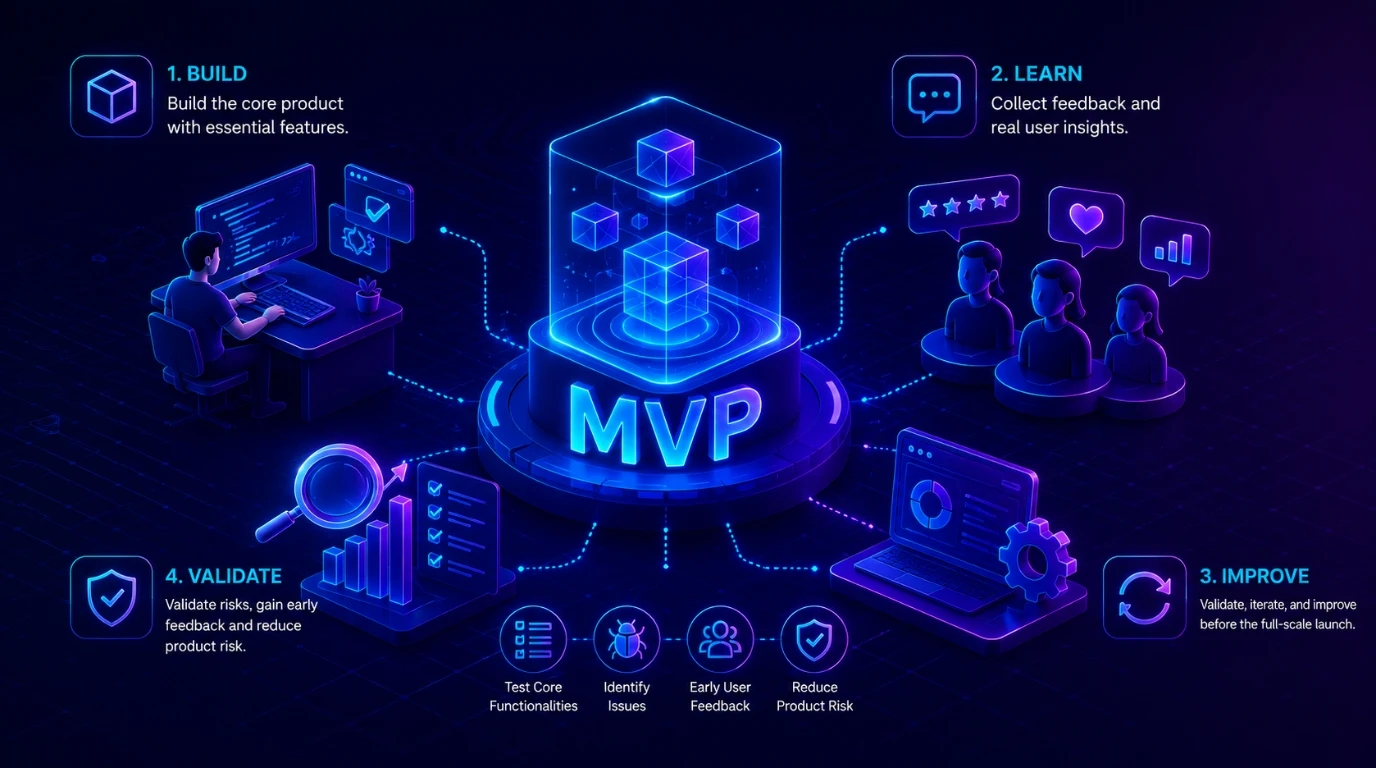
A Minimum Viable Product (MVP) helps developers determine which features will work and which will not work. It also helps them decide which features are necessary and which are not. The goal is to deliver the best product to the customers and minimize the risk of failure.
Entrepreneurs often become excited about their ideas and rush to launch products without validating whether customers actually need them.
What Does MVP Mean in Software Development
In the software development and IT industry, MVP is the most basic version of an application or website. It is specifically made for the purpose of testing its features and capabilities. It is usually distributed among a limited number of users or just to the in-house development team. All the bugs, glitches, and UI issues are tested, polished, and fixed in the MVP.
The Purpose of MVP Development
The main purpose or goal of an MVP is to determine and prove that the product will work in the intended market. During the early stages of development, an MVP is used to validate the risks, such as user data security. Feedback is taken from early adopters to further polish the product.
Why Feature Prioritization Is the Core of MVP Development

Feature prioritization in MVP is the process of choosing and ranking which features are important for the basic version of your digital product. It is different from the actual full-fledged development of the software, as this only focuses on the features and not anything else, like the UI.
It is to test the viability of the product while using as few resources as possible. Through hypotheses and research, it is determined what features the users need and how they will behave while using the software.
Through feature prioritization, teams can avoid adding unnecessary features while making sure the product solves real-world problems effectively.
The Cost of Building Too Many Features
If during the MVP design, you add too many features assuming that the users need all of them, then you would fall into a rabbit hole of not being able to decide which are useful. This is one of the most common challenges businesses face during mobile app development, and it often leads to wasted investment and delayed launches.
The Risk of Building Too Few Features
If you start with very few features, that means you have not understood the core issue that your software is going to solve. You have to research and perform a survey to understand what your target user base wants. An MVP that lacks critical features may fail to solve the user’s core problem, resulting in poor feedback and additional development cycles.
How to Define MVP Features: A Step-by-Step Framework
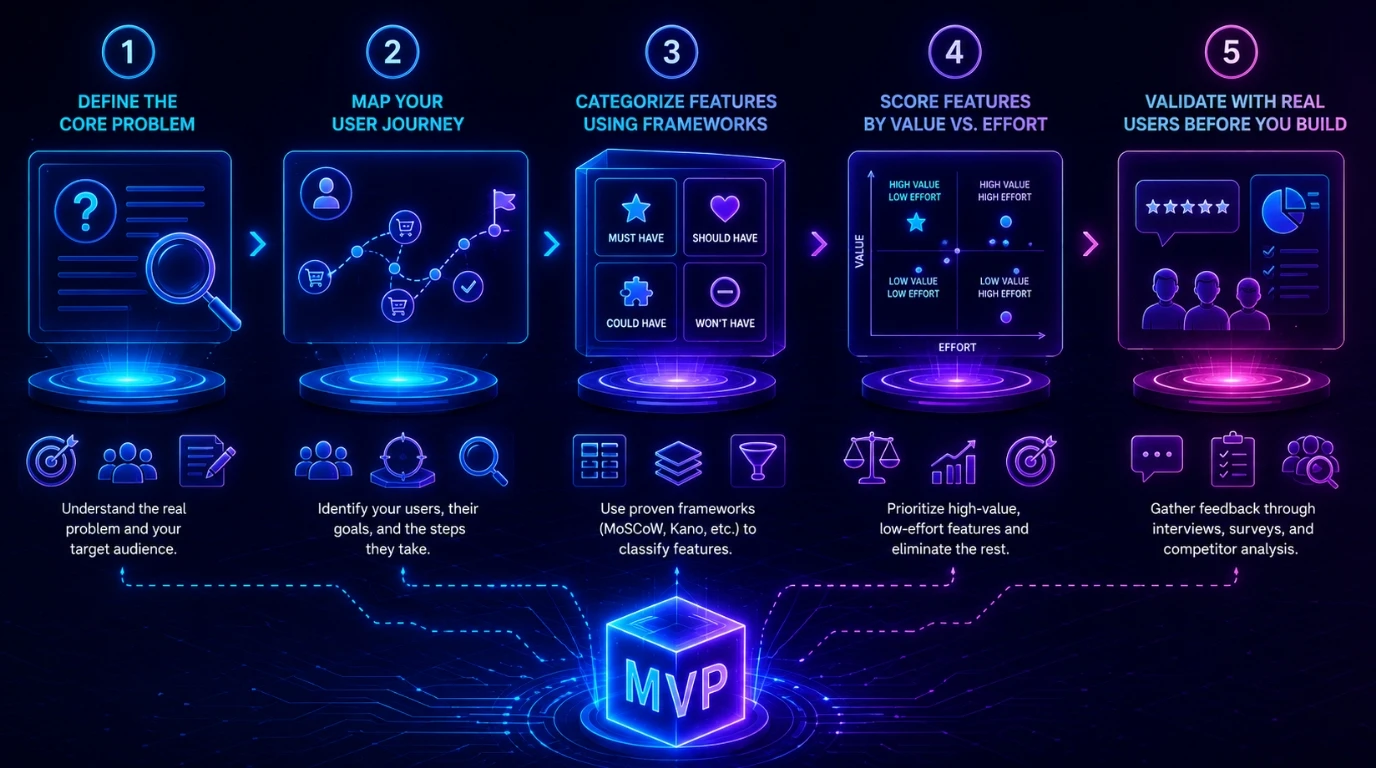
If you follow the step-by-step framework mentioned here, you will be able to make successful MVPs instead of wasting your time and money on failed products.
Step 1 - Start With Your Core Problem Statement
Begin by understanding and documenting the core problem statement that you aim to solve with your product. This will help you understand your customers. Most founders come up with solutions for problems that do not even exist.
Step 2 - Map Your User Journey
You must be as precise as possible to determine who your audience is going to be. You have to know one thing: you cannot make your product for everyone. Your product will cater to a part of society.
Step 3 - Categorize Features Using the Frameworks
This is where most development teams make mistakes. They prioritize features based on assumptions about which ones would work and which ones would not. The best and most efficient way to determine that systematically is by using proven frameworks. Teams also benefit from understanding whether custom software suits them better than off-the-shelf solutions before locking in their feature set.
Step 4 - Score Features by Value vs. Effort
In this step, you are to classify the features of your software into value and effort. The features with the highest value and least effort should be given more priority. The features with the least value should be immediately scrapped.
Step 5 - Validate With Real Users Before You Build
Before you build the final version of your software, you must take customer feedback and reviews. Have a direct conversation with the customers, conduct surveys, and do competitor analysis. Working with experienced custom software development services in USA can help you structure this validation process more effectively.
How Do You Decide What To Include In An MVP?
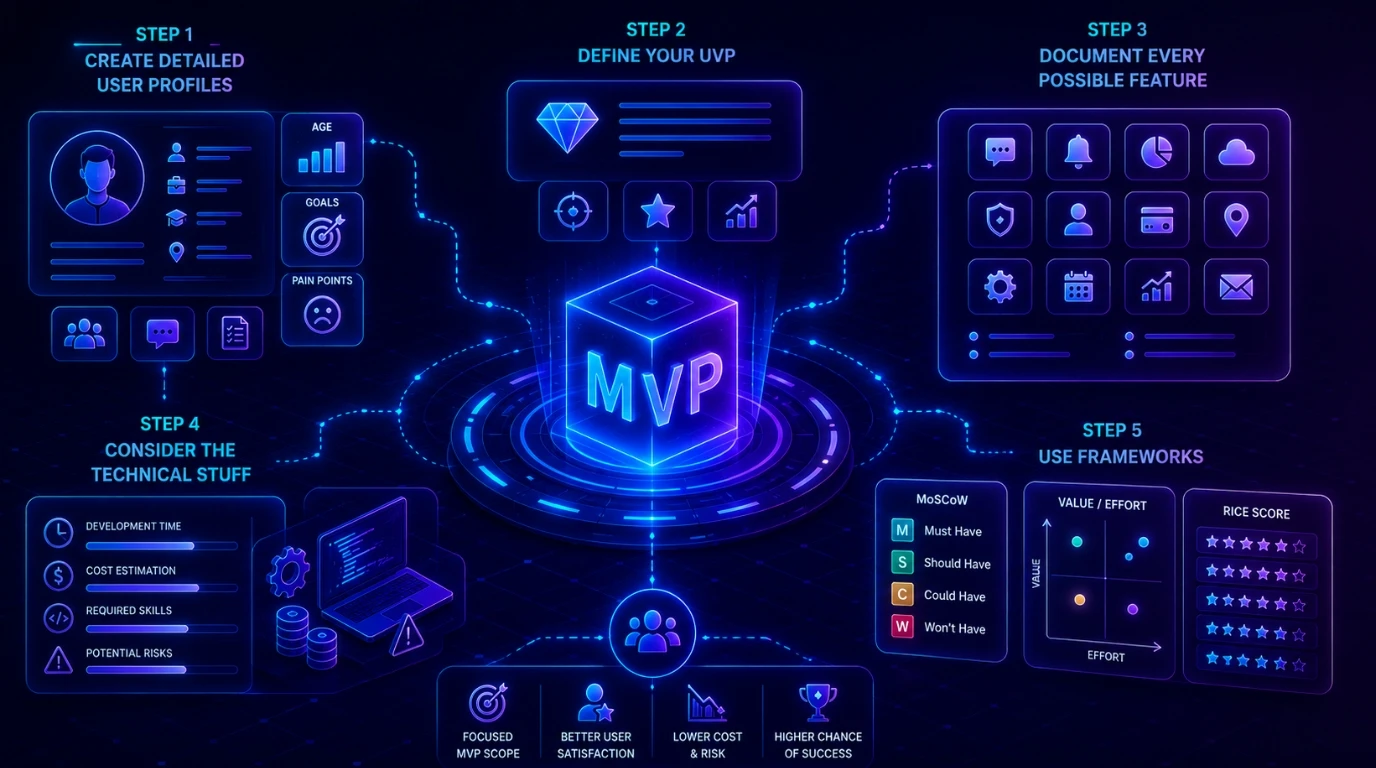
- Create detailed user profiles:
Know your users thoroughly. Take surveys and feedback. The demographics, job titles, age, etc of your users. How do they solve the problem right now? What type of solution will make them switch to your product? - Define your UVP:
Your UVP (Unique Value Proposition) should be 1-2 sentences long, defining how you will solve the problem. - Document every possible feature:
Document every possible feature you can think of or want to add. This will help you filter out. - Consider the technical stuff:
Consider how long a feature would take to develop, the costs, and the skills required. What can go wrong during its development? - Use frameworks:
Utilize frameworks to decide which features should be added to your application.
How to Prioritize Features for MVP: Popular Frameworks Compared
There are several frameworks used in the MVP development process. These frameworks help developers decide which features to include and which to avoid. They offer different ways that developers can organize and rank features based on their team size, industry, and product type. Here is the comparison of some of the most popular frameworks.
| Framework | Main Idea | How It Works | Best For |
|---|---|---|---|
|
MoSCoW Method
|
To prioritise features on the basis of importance
|
Divides features into Must-Have, Should-Have, Could-Have, and Won’t-Have
|
MVP feature planning
|
|
Kano Model
|
To understand which features will have higher user satisfaction
|
Groups features into Basic, Performance, and Excitement
|
Improving user experience
|
|
RICE Scoring (Reach, Impact, Confidence, Effort)
|
To quantitatively compare different features
|
Calculates feature score by: (Reach × Impact × Confidence) ÷ Effort |
Data-driven decisions
|
|
Opportunity Scoring
|
To find out how important a feature is and how satisfied the users are with it
|
If a feature has high importance and low satisfaction, it is considered a high opportunity
|
Identifying market opportunities and innovation
|
The Role of Your MVP Development Team in Feature Decisions
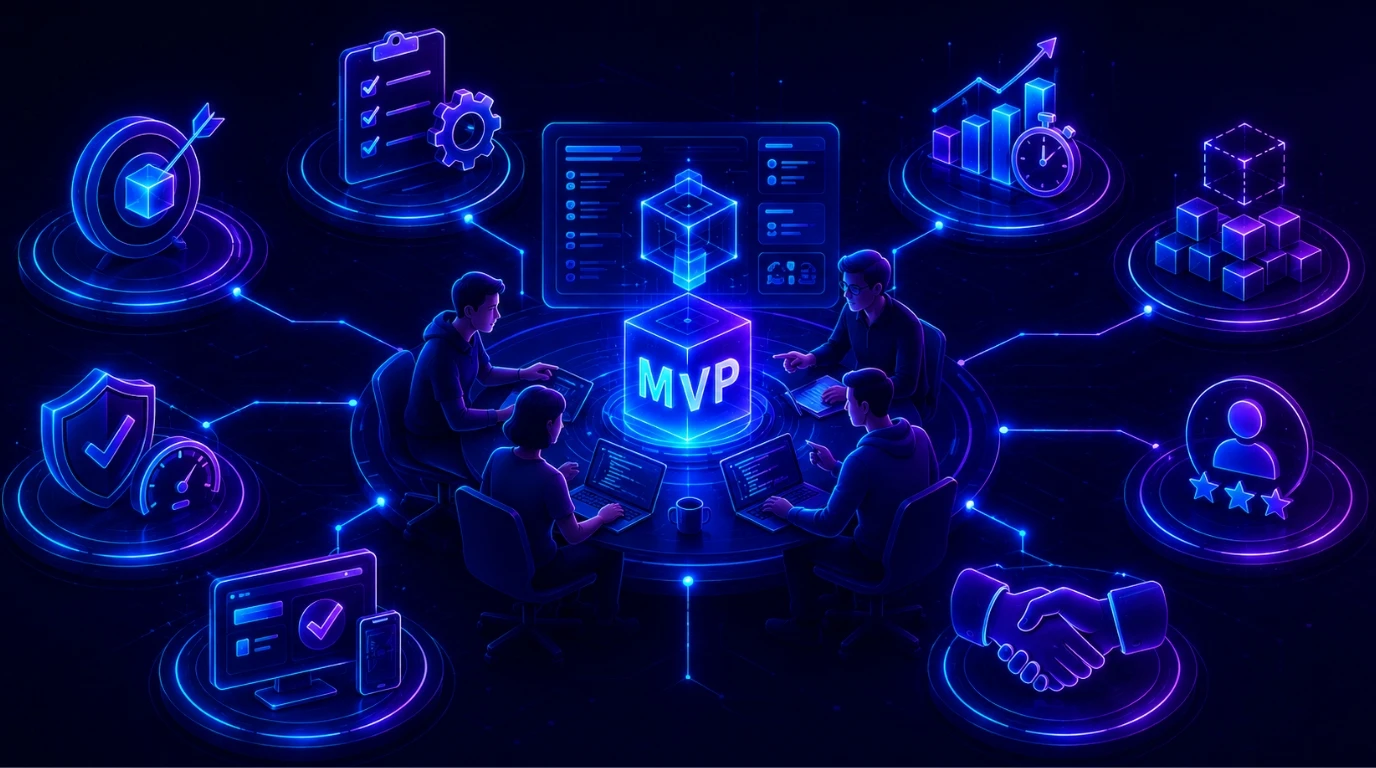
- Identifying Core Features:
The development team helps determine which features are essential for solving the main problem. - Evaluating Technical Aspects:
They assess whether features can be built within the available timeline, budget, and technology. - Reducing Unnecessary Complexity: Providing Useful Insights:
MVP teams often use past experience to recommend features that can improve usability and faster adoption. - Balancing Quality and Launch:
The team ensures the MVP launches quickly without compromising essential functionalities and performance. - Scalability Planning:
Developers help create a foundation that allows future features to be added easily. - Improving User Experience:
The team gives ideas that make the MVP more user-friendly. - Collaborating with Stakeholders:
The development team works closely with clients, designers, and product managers to facilitate better decisions.
Common Mistakes When Deciding MVP Features
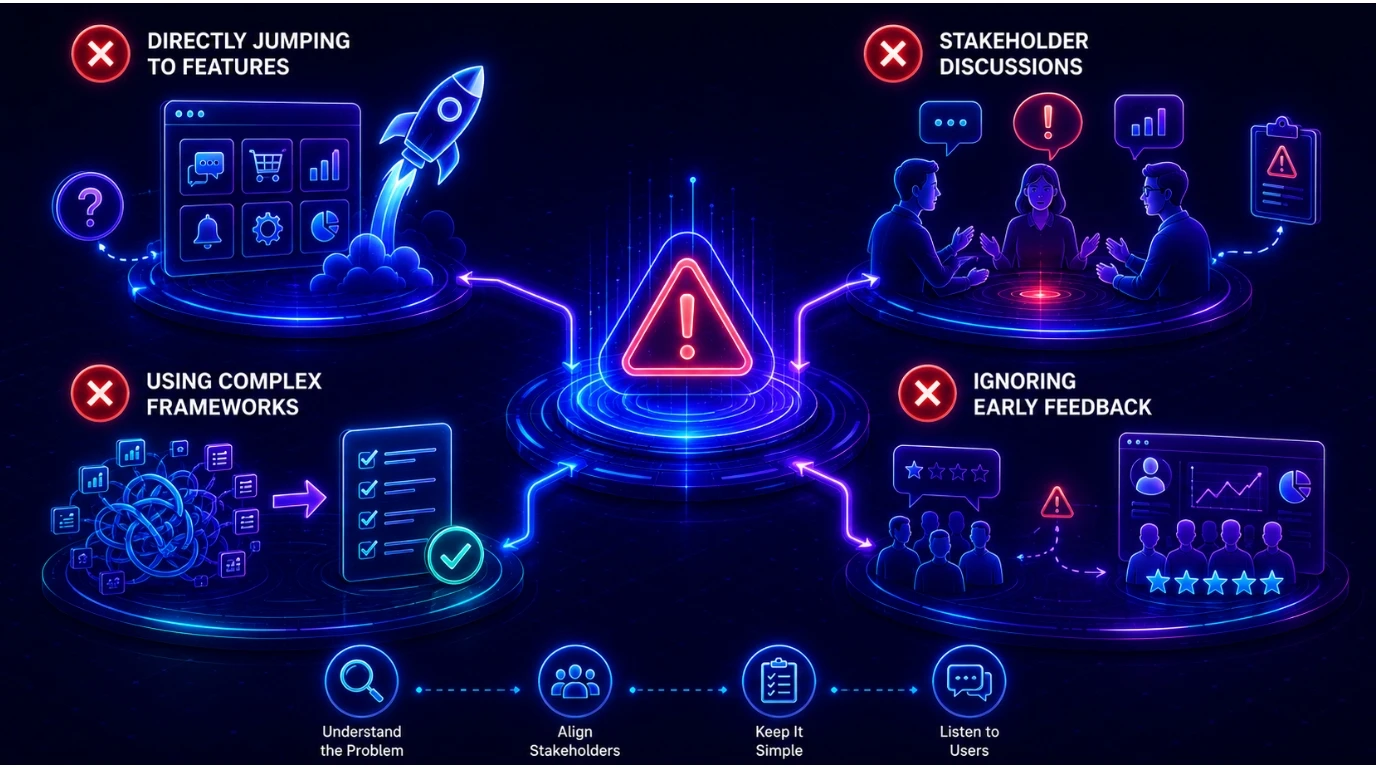
- Directly Jumping to Features:
Even some of the best software developer companies in USA jump to prioritizing features before fully understanding the user problem.
- Stakeholder Discussions:
If stakeholders are not updated on the latest status of the project, disagreements can happen in later stages, and the project scope can change. - Using Complex Frameworks:
Start with a basic and simple framework that your team can understand. Move to a more complex framework only when necessary. - Ignoring Early Feedback:
Always update priorities after receiving feedback from users.
- Directly Jumping to Features:
Conclusion
Developing MVPs is a stage of software development, and even a good app development company in USA might overlook it. Always begin with an MVP whenever you want to launch a new digital product in the market. It will help you save time, money, and manpower. You would also be able to get higher customer satisfaction ratings and engagement if you start with MVPs.
Remember, it’s okay if the MVP is not perfect. In fact, it is not even supposed to be perfect. It is just a stepping stone in your development journey. It will teach you everything you need to know about your product and the users.
Ready to build? Contact Our Global Teams
🇺🇸 USA: +1 (919) 629-9671
🇬🇧 UK: +44 20 3581 6366
🇮🇳 India: +91 99099 84567
🇦🇺 AUS: +61 07 3121 3147

💬 Interested in Regular Insights on Software and App Development?
📲 Follow Shaligram Infotech on LinkedIn
Let’s build the future of applications together.
FAQs
What is the difference between an MVP and a prototype?
What is the difference between an MVP and a prototype?
A prototype is a model used to test ideas and design concepts, while an MVP is a functional product with core features that real users can use. Prototypes validate initial concepts, whereas MVPs validate market demand through actual user feedback.
How do you know when your MVP is ready to launch?
How do you know when your MVP is ready to launch?
An MVP is ready to launch when its core features effectively solve the main user problem and provide a stable experience. It should be functional enough for real users to test, use, and provide meaningful feedback for future improvements.
Should MVP features be decided by the product team or the client?
Should MVP features be decided by the product team or the client?
MVP features should be decided collaboratively by both the client and product team. Clients provide business goals and market understanding, while the product team contributes technical expertise and insights to prioritize the most valuable and practical features.
How many features are too many for an MVP?
How many features are too many for an MVP?
An MVP has too many features when it includes functions beyond solving the core user problem. Extra features increase development time, cost, and complexity. It reduces the speed and efficiency that make MVP development valuable in the first place.
What happens if you get MVP feature prioritization wrong?
What happens if you get MVP feature prioritization wrong?
Incorrect feature prioritization can delay product launches, increase costs, and confuse users. Missing essential features may reduce product value and unnecessary features create complexity.
Is MVP development only for startups, or can enterprises use it too?
Is MVP development only for startups, or can enterprises use it too?
MVP development is useful for both startups and enterprises. Startups use it to validate ideas quickly, while enterprises use MVPs to test innovations, reduce risks, explore new markets, and gather customer feedback before making large-scale investments.Artificial intelligence helps improve mobile apps by delivering personalized user experiences, automating repetitive tasks, enabling predictive analytics, and enhancing security features. AI-powered mobile applications help businesses increase user engagement, streamline operations, and make smarter decisions based on real-time data insights. Contact our experts to build intelligent, scalable mobile app solutions for your business needs.
How much does MVP development typically cost?
How much does MVP development typically cost?
MVP development costs vary depending on product complexity, features, technology stack, and development resources. Simple MVPs may cost a few thousand dollars, while complex applications require larger budgets. The objective is to minimize costs by focusing only on essential features.


 Get In Touch